
Latin name
Gymnodiptychus dybowskii
Other Names
The naked osman is known by several alternative names, including scaleless osman and Dybowski's osman. Its scientific name, Gymnodiptychus dybowskii, was given by Kessler in 1874. The species is also known by the synonyms Diptychus dybowskii, Diptychus przewalskii, Diptychus kessleri, and Diptychus lansdelli. In Russian, it is called Голый осман (golyi osman); in Chinese, it is known as 新疆裸重唇鱼 (Xinjiang naked heavy-lipped fish). The genus name Gymnodiptychus comes from the Greek words "gymnos" (naked), "di" (two), and "ptyx" (fold). The species is named in honor of Polish zoologist Benedykt Dybowski.
Identification
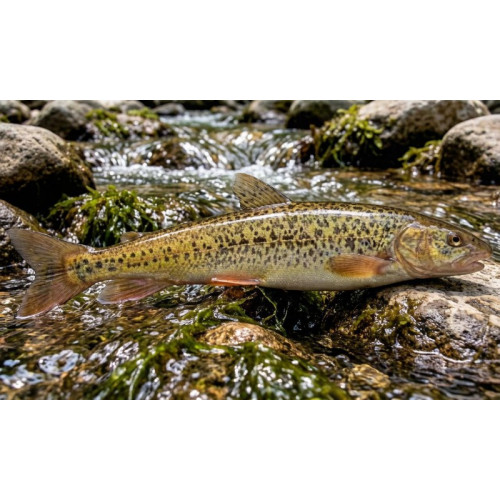
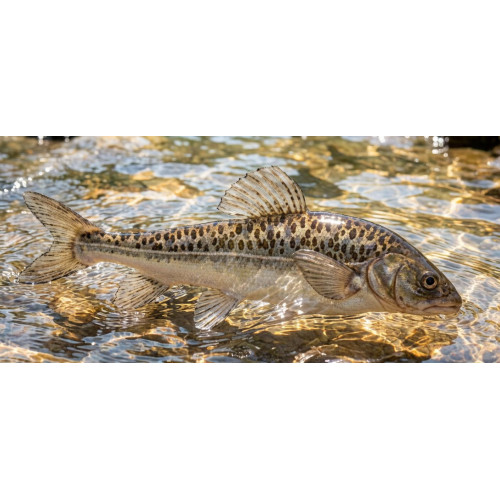
The naked osman has an elongated, fusiform (spindle-shaped) body that is slightly compressed laterally. The body is almost completely naked, with scales present only along the lateral line (82–110 scales), in the area of the "cleft," and at the base of the pectoral fins, with particularly large scales near the anal opening. The head is conical with a blunt snout. The mouth is inferior (positioned on the underside of the head) and horseshoe-shaped, with a single pair of small barbels at the corners of the mouth, about 1.5 times the length of the eye diameter. The eyes are moderately large and positioned laterally on the head. The lateral line is complete and nearly straight, reaching the base of the tail fin.
Features of Fish Fins
The dorsal fin has 3 or 4 unbranched rays (spines) and 7 to 9 soft rays (typically 8), with the last unbranched ray being weak and smooth. The anal fin has 2 to 3 unbranched rays and 5 soft rays. The pectoral fins have 1 spine and 16–18 soft rays, and the pelvic fins have 1 spine and 8–9 soft rays. The caudal fin is deeply forked, with lobes approximately equal in length. The dorsal fin origin is slightly in advance of the pelvic fins.
Fish Colouring
The colouration of the naked osman varies depending on its habitat. In murky rivers, fish are generally darker, with a bluish back and silvery sides. In lakes and warm oxbows, they take on a brownish-golden hue. Newly preserved specimens have a greyish-brown or dark grey head and back with many dark brown spots, while the underside is light yellow; the dorsal and caudal fins are brownish with spots, and the remaining fins are light yellow.
Distribution
The naked osman is widely distributed in Central Asia. It is found in the Syr Darya and Tarim river basins, as well as the endorheic basins of lakes Issyk-Kul, Balkhash, Zaysan, and Alakol. Its range includes Kazakhstan, Kyrgyzstan, Uzbekistan, and parts of China (Xinjiang).
Habitat
This species is a freshwater, benthopelagic fish that inhabits both rivers and lakes. It is typically found in cold waters (6–8°C) in the upper reaches of rivers in mountainous zones, as well as in warmer oxbows. In Lake Issyk-Kul, it is most numerous and can be found at depths of up to 40 meters, among rocky and muddy substrates with aquatic vegetation.
Size
The naked osman can reach a maximum total length of 45–50 cm and a maximum published weight of 3.0 kg. The common length is around 23 cm. Maturity is reached at lengths of 9–14 cm, depending on sex and population.
Behavior
The naked osman is a schooling species that is well-adapted to both riverine and lacustrine environments. There are two distinct forms: the lake form and the river form. The lake form is more numerous and lives in Lake Issyk-Kul, while the river form inhabits the rivers that flow into it and spawns in the rivers. The species is slow-growing. It can live in a wide range of habitats, from fast-flowing streams to still waters.
Food and Feeding Habits
The naked osman is an omnivorous species that feeds primarily on benthic invertebrates. Its diet includes insect larvae and pupae, amphipods, mollusks, and small fish. Juveniles and immature fish also consume algae and aquatic vegetation, though plant matter makes up a smaller part of the diet than animal prey. Large adults are predominantly mollusk-eaters and may also feed on small fish.
Reproduction
The naked osman has two distinct reproductive forms: lake and river. River form: Spawns in rivers on gravel beds in July–August at water temperatures of 10–12°C. Males mature at 4–5 years (19–24 cm), females at 6–7 years (22–24 cm). Fecundity is 1,600–6,000 eggs. Lake form: Spawns in the lake from February to April on shallow gravel bars. Males mature at 4–5 years (19–24 cm), females at 7+ years (26–30 cm). Fecundity is up to 12,000 eggs. Eggs are about 2 mm in diameter, adhesive, and attach to stones before being washed under rocks to develop.
Fishing
The naked osman is a commercially important species, particularly in Lake Issyk-Kul, where it is caught using seines and nets. It is also a popular object of recreational and sport fishing. The fish is marketed fresh, dried, or salted.
Relationship with a Person
The naked osman poses a significant health risk to humans if consumed improperly. It is associated with ichthyotoxins — substances that are not destroyed by ordinary heat treatment. Its eggs (roe) and milt are poisonous, and the peritoneum (abdominal lining) of adults is also considered toxic. The toxin is not destroyed by ordinary cooking, so consumption of the reproductive organs and internal linings should be strictly avoided. The flesh itself is considered safe for consumption when properly cleaned. The species is listed as Least Concern (LC) on the IUCN Red List, with its status assessed as stable.
| Classification | |
| Phylum | Chordata |
| Class | Actinopterygii |
| Squad | Cypriniformes |
| Family | Cyprinidae |
| Genus | Gymnodiptychus |
| Species | G. dybowskii |
| Features | |
| Conservation status | Least Concern |
| Habitat | Benthopelagic |
| Life span, years | No information |
| Maximum body weight, kg | 3 |
| Maximum length, cm | 50 |
| Sailing speed, m/s | No information |
| Threat to people | Edible |
| Way of eating | Omnivore |
Naked osman
Tags: naked osman