
Latin name
Tetraodon mbu
Other name
Mbuna pufferfish, giant pufferfish, or giant freshwater pufferfish.
Identification
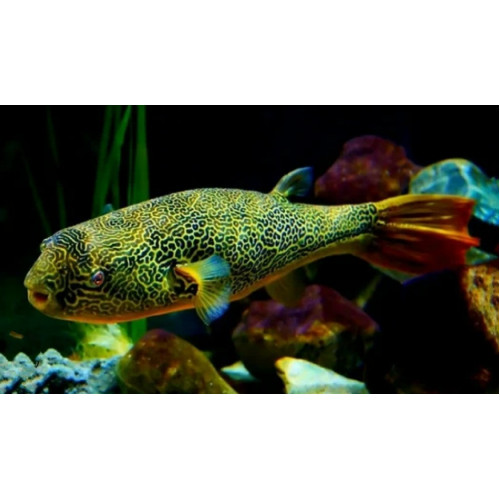
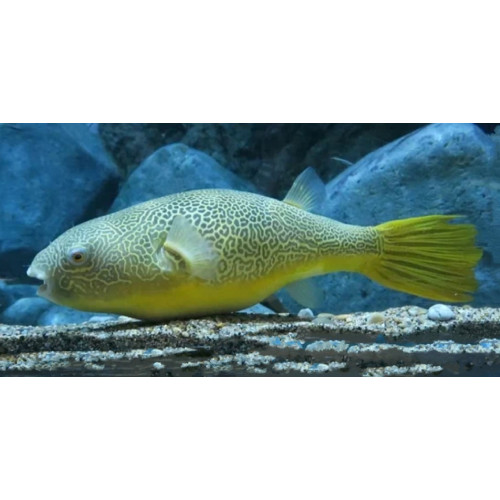
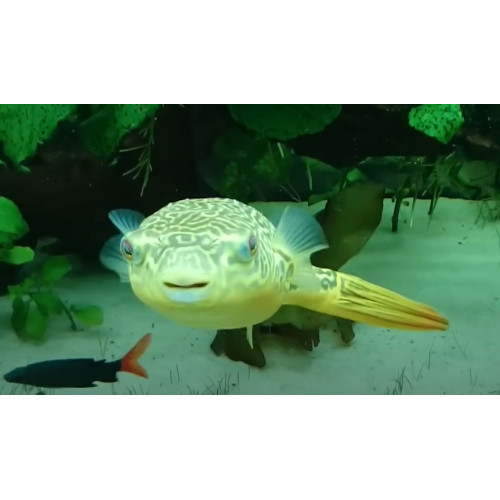
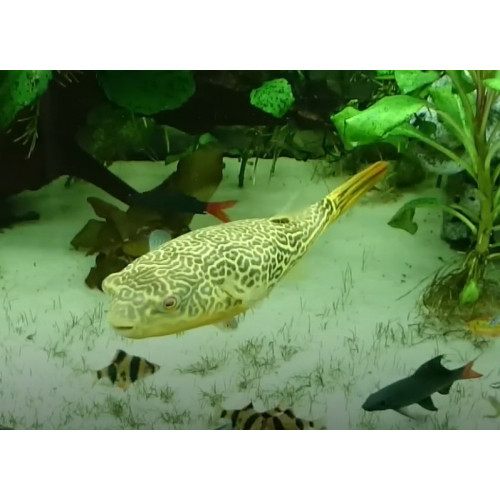
The Mbu pufferfish is the largest representative of the pufferfish family in the world. It is a massive fish with a characteristic "upturned" profile and large, expressive eyes that it can rotate independently of each other, as well as blink. The body shape is sac-like, ovoid, sharply tapering toward the tail. The skin is covered with small spines that lie flat against the body when at rest.
The upper and lower jaws are transformed into a powerful beak with visible median sutures, creating the illusion of four separate teeth — hence the genus name Tetraodon ("four-toothed"). The beak consists of four plates (two on top and two on bottom), each of which is a package of many thin layers of enamel-like tissue. These layers are stacked on top of each other like a stack of blades. The beak grows throughout life. As the front "blades" wear down, new ones emerge from the base.
Visually, this fish appears "naked" until it begins to move. It is precisely thanks to its pectoral fins and its large orange tail that it resembles a slowly gliding underwater balloon.
Features of fish fins
Pectoral fins – 2 pieces. These are the primary means of locomotion. They are located on the sides just behind the head, resemble small fans or "wings," and allow the fish to move forward and backward with exceptional maneuverability.
Pelvic fins – 0 pieces. Unlike many fish, the Mbu pufferfish lacks them. This is a common feature of pufferfish — they evolutionarily abandoned them in favor of their rowing pectoral fins.
Dorsal fin – 1 piece. Located on the back closer to the tail. It is not as large and bright as the caudal fin.
Anal fin – 1 piece. Located on the underside opposite the dorsal fin. It works in tandem with it, stabilizing the fish and preventing it from tipping over during slow swimming.
Caudal fin – 1 piece. This is the main ornament of the adult. The tail of these fish is rounded and colored bright orange or yellow. In fully grown specimens, it drapes behind them like a luxurious veil.
Adipose fin – 0 pieces. Absent. The Mbu pufferfish has only soft fins (both the dorsal and anal fins consist of soft rays without rigid spines).
Fish coloring
The coloration is light beige, golden, or yellowish with a unique labyrinthine pattern of dark stripes and spots that resembles a marble pattern. This pattern is individual to each fish and becomes more pronounced with age. The Mbu pufferfish is distinguished from other members of the genus Tetraodon by its labyrinthine skin pattern, unlike the spotted or striped pufferfish, such as the Fahaka pufferfish.
Distribution
This fish species is native to Central and East Africa. It is widely distributed in the Congo River basin and Lake Tanganyika, and is also found in the lower reaches of the Malagarasi River in Tanzania.
Habitat
It is a demersal (bottom-dwelling) fish that prefers large rivers, lakes, and estuaries with a water temperature of +24…+26°C (75–79°F). In the wild, juveniles can be found in brackish estuarine waters.
Size
Due to its large size, this fish is often called the giant freshwater pufferfish. It can grow up to 67 cm (26 inches) in length. The typical size in the wild is about 60–67 cm (24–26 inches). Aquarium size is usually 55–67 cm (22–26 inches), depending on tank volume. Maximum weight is up to 6.5–7 kg (14–15 lbs), confirmed for individuals around 75 cm (30 inches).
Their lifespan is directly dependent on keeping conditions — with proper care, they can live for more than a decade, whereas in unsuitable conditions they die within a few months. Under optimal conditions (large aquarium, good care), they live 12–15 years (some reports say up to 15–20 years). In captivity (average statistics), about 10 years. In a small aquarium (less than 500 liters / 132 gallons), only a few weeks or months.
Behavior
A solitary, territorial predator that actively defends its territory. It possesses developed intelligence and over time is capable of recognizing its owner.
Like all pufferfish, the Mbu pufferfish can inflate into a ball by filling a special pouch with water (or air at the surface). At the same time, the spines on its skin stand erect, making the fish practically inedible to predators.
Food and feeding habits
They feed on small fish, mollusks, crustaceans, snails, worms, and crayfish. Species kept in captivity require a varied diet that includes items with hard shells to maintain health and prevent excessive tooth growth. The powerful beak is designed for cracking the hard shells of mollusks and crustaceans.
Reproduction
In captivity, the Mbu pufferfish does not breed. To date, there has not been a single successful case of breeding this species in home aquariums. All individuals available for sale are caught in the wild.
Fishing
In African countries, this fish is not eaten and has no commercial fishing value.
Relationship with a person
The meat of the Mbu pufferfish, like that of many pufferfish species, contains the deadly neurotoxin tetrodotoxin.
Due to their large size, keeping such fish in home aquariums is difficult, as they require a very large aquarium and an appropriate water filtration system.
| Classification | |
| Phylum | Chordata |
| Class | Actinopterygii |
| Squad | Tetraodontiformes |
| Family | Tetraodontidae |
| Genus | Tetraodon |
| Species | T. mbu |
| Features | |
| Conservation status | Least Concern |
| Habitat | Bottom |
| Life span, years | 20 |
| Maximum body weight, kg | 7 |
| Maximum length, cm | 67 |
| Sailing speed, m/s | No information |
| Threat to people | Not edible |
| Way of eating | Predator |
Mbu pufferfish
Tags: mbu pufferfish