
Latin name
Malapterurus electricus
Other name
Electric catfish, Silurus electricus.
Identification
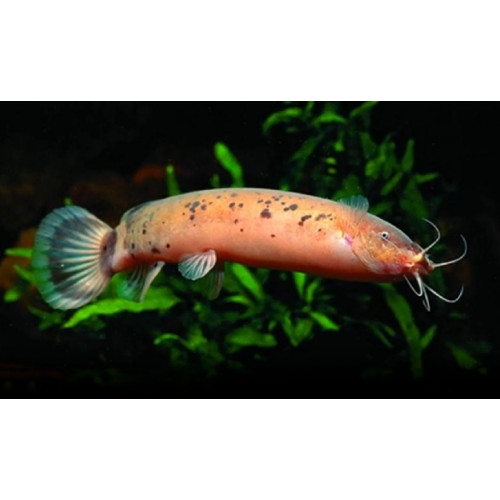
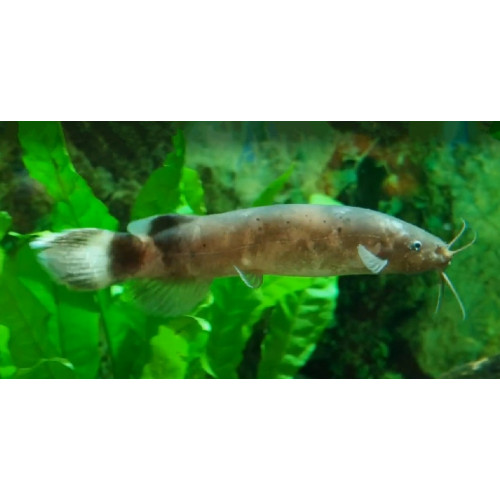
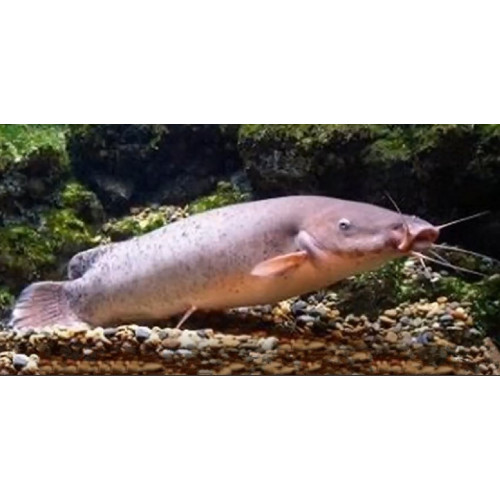
Malapterurus electricus has a characteristic appearance that distinguishes it from most other catfish. It has an elongated, cylindrical (rounded) body in cross-section, not a flattened belly like others. The head is large, the mouth is terminal and wide, with tiny eyes. It has three pairs of barbels (6 total) arranged around the mouth. The barbels are mobile and function as sensitive feelers.
Main weapon: the electric organ. This is the most remarkable feature of the fish, which gave it its name. It is a modified pectoral muscle that forms a continuous gelatinous layer under the skin, surrounding almost the entire body (except for the tail region). The mass of this organ reaches about 25% of the fish's total weight. The catfish can generate a discharge ranging from 300 to 450 volts. The power depends on the size of the fish and decreases rapidly with fatigue. Malapterurus electricus stuns or kills its prey with an electric shock, then swallows it. It also uses this organ for defense against predators or when sensing danger. The electric field generated around its body allows the catfish to detect objects and prey in murky water.
Features of fish fins
The dorsal fin is completely absent — this is a key distinguishing feature of the species. In its place, there is a well-developed adipose fin located closer to the tail. The anal fin is short (9–11 rays), and the caudal fin is fan-shaped, rounded, with 7–8 rays.
Fish coloring
The main body color is gray, brownish, or reddish-brown with a pinkish tinge. Numerous dark spots of varying sizes are scattered across the body. The caudal fin has a dark base and a wide red or orange-red margin. Males are slimmer and more elongated than females.
Distribution
This species is widely distributed in tropical Africa. It is found in the basins of Africa's largest rivers – the Nile (excluding Lake Victoria), Niger, Volta, and Senegal – as well as in Lakes Chad and Turkana. In the Congo River basin, this species is absent; other species of electric catfish inhabit that region.
Habitat
Prefers still or slow-moving waters. It stays among rocks, submerged branches, and tree roots, where it can hide during the daytime.
Size
Malapterurus electricus reaches up to 122 cm (48 inches) in the wild, typically 60–100 cm (24–39 inches). Maximum weight is up to 23 kg (51 lbs). The maximum recorded lifespan in the wild is 10 years.
Behavior
A benthic, solitary, nocturnal predator. During the day, the catfish is sluggish and hides in shelters; at dusk, it emerges to hunt. It can produce fairly loud sounds using a specialized "vocal" apparatus connected to the swim bladder. When it discharges, electrolysis of the water occurs around the catfish's body, releasing oxygen, which attracts other fish – the catfish uses this as an additional hunting tactic.
Food and feeding habits
The diet consists primarily of fish, which the catfish stuns with its electric shock. Juveniles feed mainly on aquatic invertebrates. In captivity, they are omnivorous: accepting fish, shrimp, squid, worms, beef, as well as dry and frozen foods.
Reproduction
In the wild, they reproduce strictly in pairs. The male digs a pit about one meter (3.3 feet) in diameter at the bottom or uses natural caves, where the female lays her eggs. The male guards the clutch. There is unconfirmed data that he may carry the eggs in his mouth. To date, there are no verified reports of successful breeding of electric catfish in aquariums — all individuals available for sale are caught in the wild.
Fishing
In the African countries where this species lives, it is an object of local fishing and is eaten. Although the meat of this fish is perfectly edible, the process of catching and cleaning it is associated with serious danger. Its electric discharge is a sufficiently powerful shock capable of causing pain and even temporary paralysis in a person. In its natural habitat, Malapterurus electricus is treated as an ordinary, albeit requiring caution, commercial fish.
Relationship with a person
It poses a real danger. There are known cases where swimmers received a strong electric shock after stepping on the catfish in the water. Despite the danger, electric catfish are sometimes kept in home aquariums. When working with water in such aquariums, extreme caution must be exercised, and the fish must not be provoked.
Malapterurus electricus was well known in ancient Egypt. Depictions of this fish are found on tombs dating back as far as 6,000 years. The Egyptians used the catfish in folk medicine — applying it to painful areas for treatment (a form of electrotherapy).
| Classification | |
| Phylum | Chordata |
| Class | Actinopterygii |
| Squad | Siluriformes |
| Family | Malapteruridae |
| Genus | Malapterurus |
| Species | M. electricus |
| Features | |
| Conservation status | Least Concern |
| Habitat | Least Concern |
| Life span, years | 10 |
| Maximum body weight, kg | 23 |
| Maximum length, cm | 122 |
| Sailing speed, m/s | No information |
| Threat to people | Edible |
| Way of eating | Predator |
Malapterurus electricus
Tags: malapterurus electricus