
Latin name
Devario malabaricus
Other Names
The Malabar danio is also known as the giant danio. Its scientific name, Devario malabaricus, was given by Jerdon in 1849. The genus name Devario comes from the Bengali word 'debari', which is a local name for these fishes. The species is also known by the synonym Danio malabaricus. It is sometimes confused with Devario aequipinnatus, a different species from northeastern India.
Identification
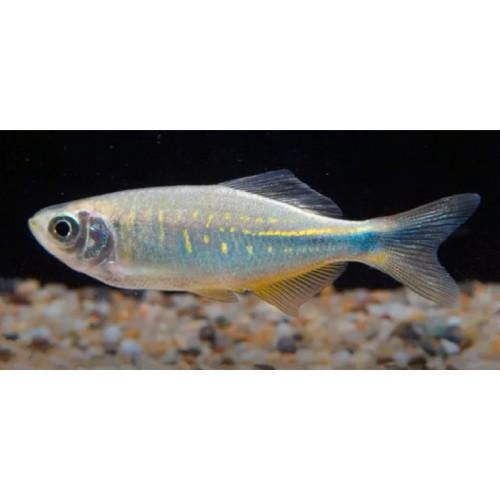
The Malabar danio has a fusiform (spindle-shaped) body and is a larger, more robust relative of the familiar zebra danio. The vertebrae number 34–36. A key identifying feature is the presence of a danionin notch and the absence of a process on the 1st infraorbital bone. The snout is subequal to or greater than the eye diameter. The species can be distinguished from the similar Devario aequipinnatus by its different native range (west coast of India and Sri Lanka).
Features of Fish Fins
The Malabar danio has a dorsal fin with 12–16 soft rays and an anal fin with 15–20 soft rays. The tip of the pectoral fin almost reaches the origin of the pelvic fin when pressed against the body. The caudal fin is forked, as is typical for the genus.
Fish Colouring
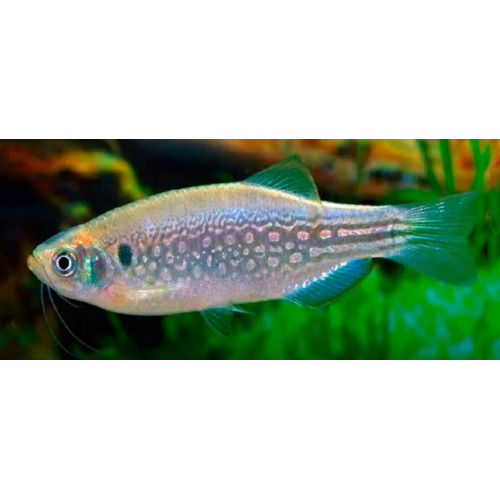
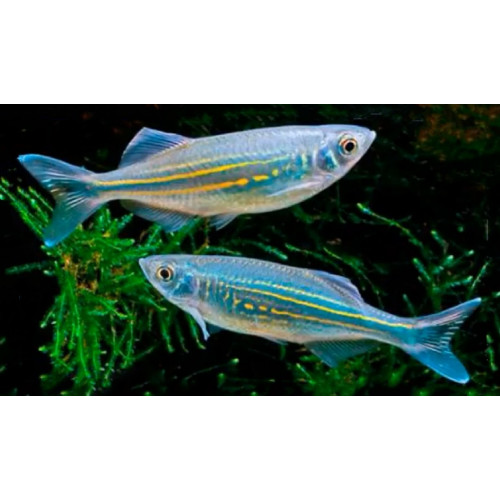
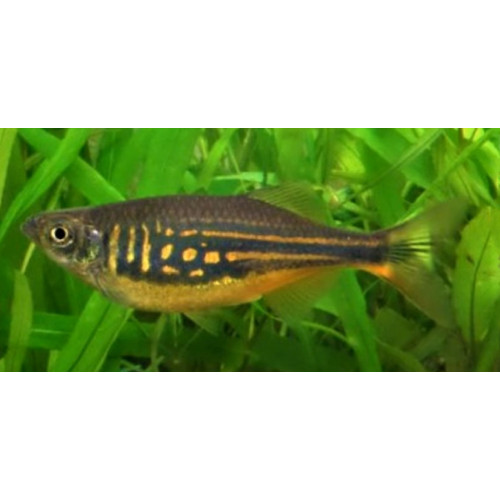
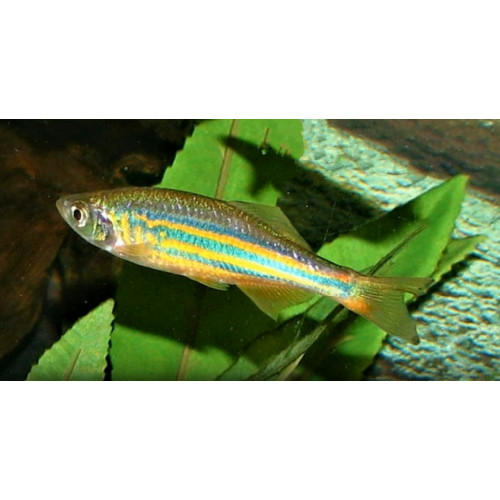
The Malabar danio has a distinctive colour pattern: a blue and yellow horizontal stripe pattern runs along the body, with the central pigment stripe extending all the way into the fork of the tail. The P stripe (the main horizontal stripe) originates level with the pelvic-fin origin, about 1–2 scale-widths anterior to the dorsal-fin origin. There are also 5–6 dark, irregular, vertical bars on the anterior half of the body, and a whitish line bifurcates the P-1 stripe anteriorly. Males are more colourful during the breeding season, while females are larger and fuller-bodied.
Distribution
The Malabar danio is native to tropical Asia: the west coast of India and Sri Lanka. It has been widely transported around the world through the aquarium fish trade. Introduced populations have been recorded in the United States (Florida and Nevada), but these introductions have failed.
Habitat
This species inhabits freshwater environments and is benthopelagic. It is found in a wide variety of habitats, from boulder-strewn mountain torrents to small pools in dry zone streams, though it prefers flowing water over reservoirs and tanks. It is most common in rivers and streams with dense marginal vegetation and high oxygen levels. The preferred temperature range is 18–25°C, with a pH of 6.0–8.0.
Size
The Malabar danio can reach a maximum total length of 12.0 cm (about 4.7 inches), though it rarely exceeds 10 cm in a home aquarium. The common length is around 8.0 cm.
Behavior
The Malabar danio is an active, schooling species that forms medium-sized shoals. It is a powerful swimmer and seems to be in perpetual motion, adapting well to strong water currents. It is generally peaceful, but its boisterous nature can stress slower or timid species, and it can be competitive at feeding times. It is an accomplished jumper and requires a tight-fitting cover on the aquarium. The typical lifespan is 5–8 years in good aquarium conditions.
Food and Feeding Habits
The Malabar danio is an omnivore. Its natural diet consists of terrestrial insects, insect larvae, crustaceans, and detritus. In the aquarium, it will eagerly accept most flake, pellet, and frozen foods, such as bloodworms, daphnia, brine shrimp, and Mysis shrimp.
Reproduction
The Malabar danio is an oviparous (egg-scattering) species. Spawning occurs in shallow water, among marginal weeds and roots, usually after heavy rains. Females lay more than 200 sticky, light-orange eggs that hatch in 1–2 days. Fry become free-swimming on the fifth day. Adults exhibit cannibalism on the eggs, so they should be removed from the breeding aquarium after spawning.
Fishing
The Malabar danio has no interest to fisheries. It is not a food fish and has no commercial value outside the aquarium trade. Its value lies entirely in its ornamental appeal.
Relationship with a Person
The Malabar danio is not considered a threat to humans and is classified as harmless. It is a highly commercial aquarium fish that has been widely traded around the world for many years. It is popular among aquarists for its active nature, torpedo-shaped body, and attractive colouration. The species is listed as Least Concern (LC) on the IUCN Red List, assessed on 13 August 2019.
Interesting facts
The Malabar danio is the best aquarium swimmer! During fast movement, its torpedo-shaped streamlined body bends left and right. How swift their turns are! One sharp bend of the tail and rear part of the body — and the fish changes its direction of movement by 90 to 120 degrees.
| Classification | |
| Phylum | Chordata |
| Class | Actinopterygii |
| Squad | Cypriniformes |
| Family | Danionidae |
| Genus | Devario |
| Species | Devario malabaricus |
| Features | |
| Conservation status | Least Concern |
| Habitat | Benthopelagic |
| Life span, years | No information |
| Maximum body weight, kg | No information |
| Maximum length, cm | 12 |
| Sailing speed, m/s | No information |
| Threat to people | Not edible |
| Way of eating | Omnivore |
Malabar danio
Tags: malabar danio