
Latin name
Gobio gobio
Other name
Common gudgeon
Identification
The Latin genus name Gobio comes from the word "goby," referring to its stocky shape and bottom-dwelling lifestyle.
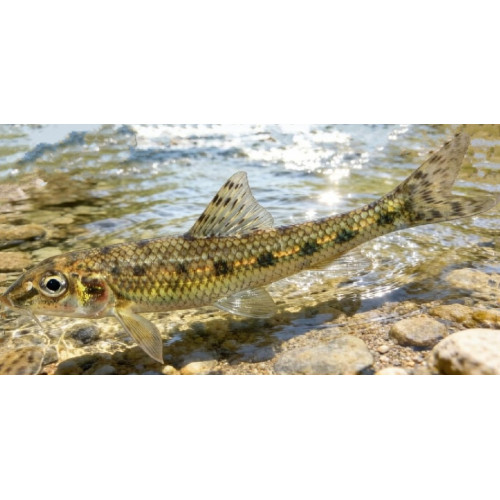
The gudgeon has a typical bottom-dwelling cyprinid body structure, easily recognized by its characteristic head shape and the presence of barbels.
The body is spindle-shaped, elongated, with a rounded belly. The head is large, broad, with a blunt snout. The head length is 26–30% of the total body length. At the corners of the mouth, there is one pair of small barbels. This is one of the main distinguishing features of the gudgeon from similar species. The barbels help the fish find food on the bottom. The scales are cycloid, medium-sized. There are 39–42 scales along the lateral line. The gudgeon has specialized pharyngeal teeth that help grind the hard shells of mollusks and insect larvae. This fish is sensitive to water pollution and serves as a kind of indicator of water quality.
Features of fish fins
The fins are quite typical for bottom-dwelling cyprinid fish: they are not very large, without bright features, but with a clear fin ray formula used for species identification.
Dorsal fin: single, small, located approximately in the middle of the back, consists of 2–3 rigid (spiny) and 5–7 soft rays. Adipose fin is absent.
Anal fin: single, short, located on the underside closer to the tail, similar to the dorsal fin, consists of 2–3 spiny and 6–8 soft rays.
Caudal fin: forked, of a more or less ordinary shape, with a total of 19 rays.
Pectoral fins: located on the sides of the body, just behind the gill covers, consist of one spiny and 12–16 soft rays. Interestingly, in males, the pectoral fins are noticeably longer than in females.
Pelvic fins: paired, located on the belly behind the base of the pectoral fins; each has 2 spiny and 6–8 soft rays.
Fish coloring
The back of the gudgeon is grayish-green or brownish; the sides are lighter, with characteristic dark spots that often merge into a vague stripe. The belly is whitish or yellowish. The fins are grayish with darker edges. The coloration can change depending on the bottom type, helping the fish camouflage.
Distribution
The gudgeon is one of the most widespread fish in the fresh waters of Europe and North Asia.
It is found in the basins of the North, Baltic, Black, and Caspian Seas. It is distributed from Great Britain and France in the west to Korea in the east. It is found in rivers and lakes throughout almost all of Europe, except for northern Scandinavia.
Habitat
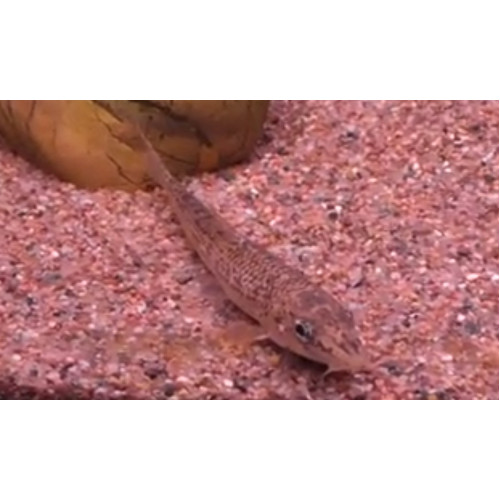
It prefers sandy or pebbly bottoms with clean water. It is found in both small mountain streams and large lowland rivers and even lakes. It is a typical benthopelagic species, meaning it stays near the bottom but may rise into the water column.
It prefers neutral or slightly alkaline water with pH 7.0–7.5, hardness of 10–20 dH, and temperatures ranging from 2 to 18°C (36–64°F).
Size
The gudgeon is a small fish. The maximum recorded length of this species is 21 cm (8.3 inches), but the average size of adults usually does not exceed 12 cm (4.7 inches). Sexual maturity is reached at a length of about 9.3 cm (3.7 inches). The maximum recorded weight is 220 grams (7.8 oz).
These fish live relatively short lives. In the wild, their maximum age reaches 8 years, with males typically living longer than females. In the first year of life, juveniles grow to about 4.5–6 cm (1.8–2.4 inches), and by the end of the second year, they may reach 7–9 cm (2.8–3.5 inches). After that, the growth rate slows down noticeably.
Thus, it is a small, short-lived fish that grows quickly in the first few years of life, after which its development almost stops.
Behavior
The gudgeon leads a very characteristic lifestyle for its genus.
It is a schooling fish that often forms numerous groups, especially during daylight hours. Juveniles prefer to stay in shallow water near the shore. It leads a diurnal lifestyle, but in case of disturbance or the presence of predators, it may shift its peak activity to twilight hours. Juvenile gudgeon stay together with juvenile Amur minnows, and during their schooling period, they develop a black stripe on their side, characteristic of the minnow, which always stays in schools.
They are capable of producing squeaking sounds. It is believed that this is a means of communication between individuals, and the nature of the sounds depends on the fish's activity and water temperature, but not on the breeding season.
Food and feeding habits
A typical benthophage, feeding on small bottom-dwelling organisms.
It feeds on insect larvae (chironomids, caddisflies), mollusks, worms, and small crustaceans, which it finds on the bottom or in the substrate. Thanks to its inferior mouth and sensitive barbels, the gudgeon thoroughly examines the bottom in search of food. Sometimes it may rise into the water column for falling food.
Reproduction
Reproduction of the gudgeon in Europe has been well studied and has its own specific features.
Spawning occurs from April to June. It spawns in shallow water with rocky, sandy, or vegetated bottoms. The eggs are released above the substrate, drift with the current, and adhere to the bottom and stones. Different populations exhibit different strategies. In water bodies with low productivity, the gudgeon spawns once per season but may spawn for several years in a row. In more food-rich areas, it is capable of spawning several times in a single season. Immediately after hatching, juveniles stay on the bottom, preferring areas with sandy bottoms rich in detritus and with weak currents.
Fishing
The gudgeon is not an important target of commercial fishing but has significance in other areas. Despite its status as a commercial fish, industrial catch of the gudgeon is insignificant. It is mainly caught as bait for predatory fish (zander, pike, catfish) and for aquariums.
Relationship with a person
The gudgeon itself is safe for humans. However, this bottom-dwelling fish is sensitive to water quality and can accumulate harmful substances in its body. Therefore, only fish caught in clean, flowing waters, preferably away from industrial zones, should be consumed.
The International Union for Conservation of Nature (IUCN) has assigned the species Gobio gobio a conservation status of Least Concern.
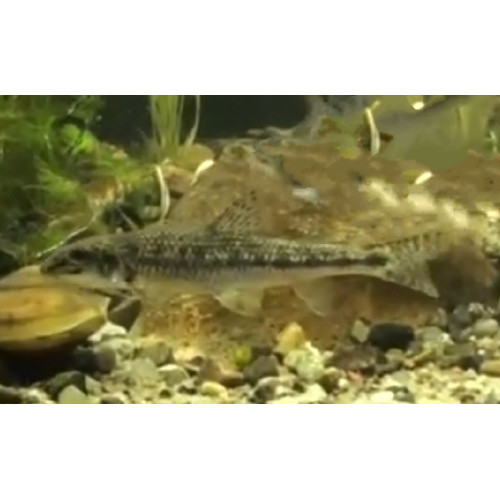
This fish species is a popular subject in the aquarium trade. Due to its interesting behavior and hardiness, it is kept in cold-water aquariums.
| Classification | |
| Phylum | Chordata |
| Class | Actinopterygii |
| Squad | Cypriniformes |
| Family | Gobionidae |
| Genus | Gobio |
| Species | G. gobio |
| Features | |
| Conservation status | Least Concern |
| Habitat | Benthopelagic |
| Life span, years | 8 |
| Maximum body weight, kg | 0,22 |
| Maximum length, cm | 21 |
| Sailing speed, m/s | No information |
| Threat to people | Edible |
| Way of eating | Bentophage |
Gudgeon
Tags: gudgeon