
Latin name
Andinoacara rivulatus, syn. Aequidens rivulatus.
Identification
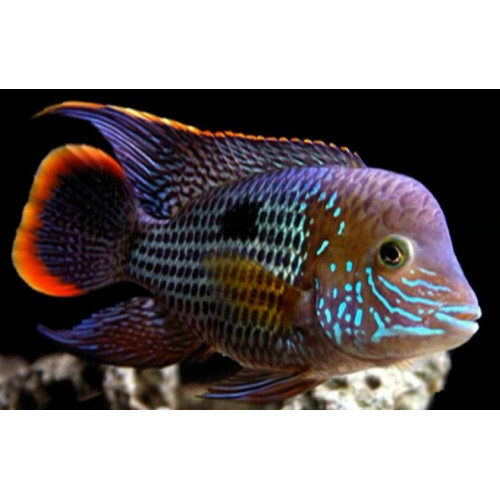
The Green Terror is a stocky fish with a prominent forehead. In adult males, a pronounced nuchal hump, composed of fatty tissue, develops on the forehead.
Features of fish fins
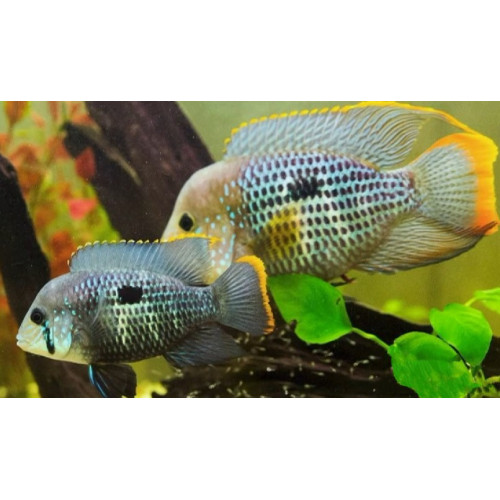
The species possesses dorsal, caudal, and anal fins. Males exhibit elongated and pointed dorsal and anal fins, while females have shorter fins.
Fish colouring
Green Terrors are polymorphic and may exhibit a white or golden-orange margin on the caudal and dorsal fins. Historically, it has been confused with two other species, which consistently display a narrow, well-defined white margin: the more southerly distributed A. stalsbergi and the more northerly A. blombergi.
Juveniles are brown with silvery-blue speckles and lack the bright iridescent blue, green, and orange coloration, as well as the elongated fins, characteristic of adults.
Distribution
This fish inhabits the Pacific slope of South America, from the Tumbes River in Peru to the Esmeraldas River in Ecuador.
Habitat
In the wild, this species occurs in a tropical climate and prefers water with a pH of 6.5–8.0, hardness of 25.0 dGH, and a temperature range of 20–24°C (68–75°F).
Size
Males are larger than females and can reach a total length of up to 30 cm (12 inches).
Behavior
Individuals in the late juvenile and adult phases can be highly aggressive. However, this is not guaranteed, and peaceful specimens can be observed.
Food and feeding habits
This species is sufficiently adaptable to survive—and even thrive—among larger cichlids. Typically, a hunting cichlid is capable of consuming any animal smaller than the size of its fully distended jaws.
The natural diet of the Green Terror consists of small fish, insects and their larvae, worms, and other invertebrates. They are predators, but in aquarium conditions, they can adapt to other food types.
Reproduction
Females reach sexual maturity at a size of approximately 12 cm (4.7 inches).
They exhibit extended biparental care. Prior to spawning, the female selects a flat stone whose color resembles that of the eggs. She meticulously cleans the stone of all debris and deposits her eggs on it. After spawning, the male and female position themselves side-by-side and fan the eggs with their fins.
Upon hatching, the parents carefully take the larvae into their mouths and transfer them to pre-dug pits in the substrate. After securing the larvae in this shelter, the parents station themselves near the nest, facing in opposite directions; at the slightest sign of danger, they are prepared to attack an intruder and defend their offspring.
As the fry grow, the parents lead them on "forays." The mother swims at the front, followed by the school of fry, while the father brings up the rear, vigilantly guarding the family.
Fishing
This species is not commercially important.
Relationship with a person
Juvenile Green Terrors are frequently sold in aquarium stores. This species should not be confused with the Blue Acara (Andinoacara pulcher), which bears a similar appearance.
A. rivulatus has been used as a model organism to study the effects of testosterone on lateralization.
| Classification | |
| Phylum | Chordata |
| Class | Actinopterygii |
| Squad | Cichliformes |
| Family | Cichlidae |
| Genus | Andinoacara |
| Species | A. rivulatus |
| Features | |
| Conservation status | Least Concern |
| Habitat | Bottom |
| Life span, years | No information |
| Maximum body weight, kg | No information |
| Maximum length, cm | 30 |
| Sailing speed, m/s | No information |
| Threat to people | Edible |
| Way of eating | Predator |
Green terror
Tags: green terror