
Latin name
Nannostomus beckfordi
Other name
Nannostomus anomalus, nannostomus simplex, nannostomus aripirangensis.
Identification
The genus name Nannostomus comes from the Latin nannus ("small") and the Greek stoma ("mouth"), referring to the small size of these fish. The species name beckfordi is given in honor of F. J. B. Beckford, who first collected this species and sent it to the British Museum.
The species was officially described in 1872 by ichthyologist Albert Günther. Since then, it has had several scientific synonyms: Nannostomus anomalus, Nannostomus simplex, Nannostomus aripirangensis, and others.
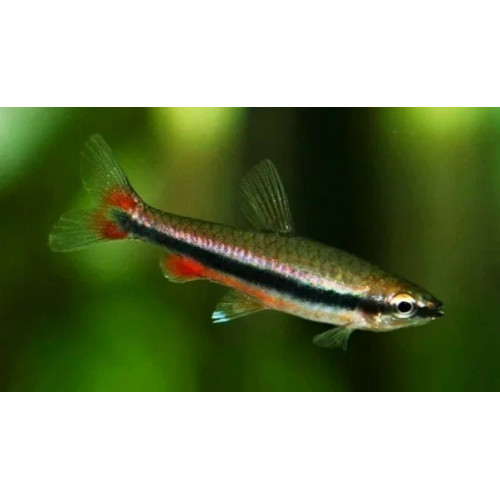
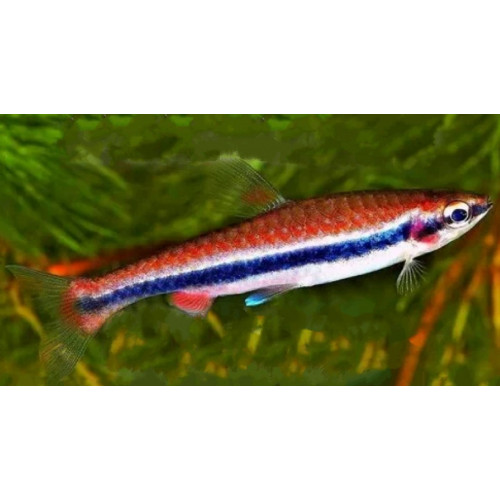
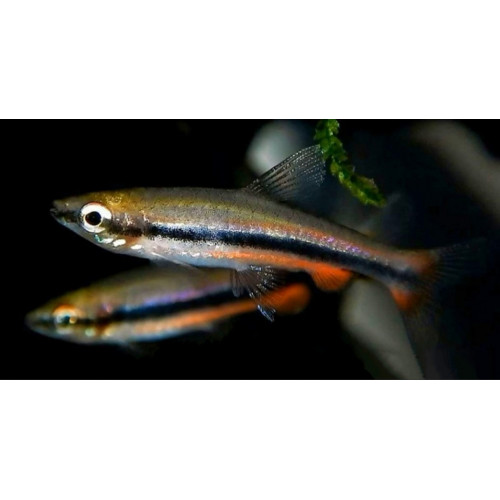
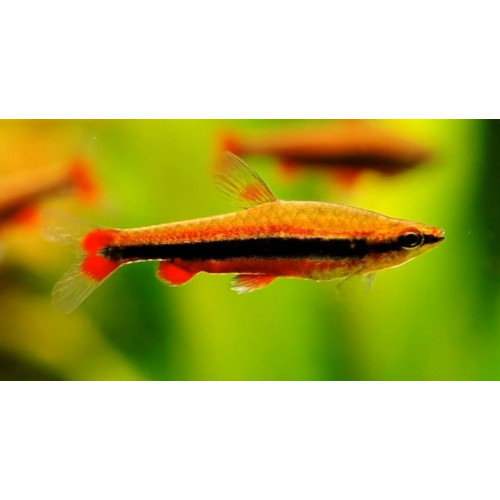
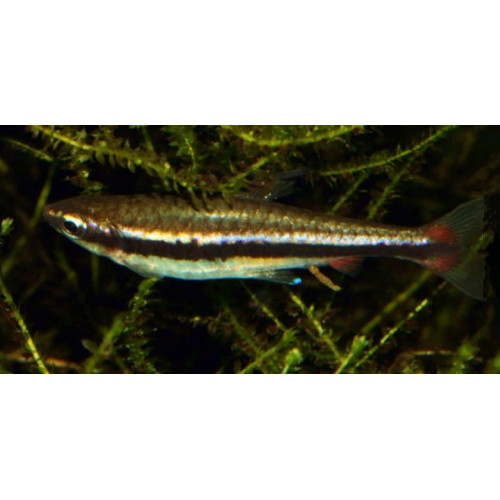
The golden pencilfish has a typical elongated "pencilfish" body but differs from its relatives in its larger size and bright coloration.
Their body is elongated, spindle-shaped, and slightly compressed laterally. The body of females is fuller, especially during spawning. The head is small, pointed, with a small terminal mouth. The dorsal profile is almost straight, the belly slightly convex.
Features of fish fins
The dorsal fin is located almost in the middle of the body. The anal fin is short, with a characteristic blue spot in males. The caudal fin is bilobed with rounded lobes. The adipose fin is absent. The pectoral fins are colorless.
Fish coloring
Daytime coloration: The main body color is reddish-brown on the back (with a greenish tint) and grayish-yellow on the sides. The belly is white with a silvery sheen. The main distinguishing feature is a broad black longitudinal stripe that runs from the snout to the base of the caudal fin, where it ends in two bright scarlet spots.
Sexual dimorphism (key difference!): Males have an additional bright red coloration on the body, as well as red stripes on the fins. On the anal fin, they have a characteristic blue spot. During the breeding season, the coloration becomes even more intense. Females are more modestly colored — they have no red stripes, and the anal fin lacks the blue spot.
Nighttime coloration: Like other Nannostomus species, with the onset of darkness, the fish "changes clothes": the longitudinal stripe disappears, and in its place, three dark oval spots appear. This is protective camouflage against nocturnal predators.
Distribution
The golden pencilfish is widely distributed in South America. Its homeland is Guyana, Suriname, as well as the Brazilian part of the Amazon and Rio Negro river basins.
Habitat
In the wild, these fish inhabit small rivers with weak currents, streams, and swampy areas. They prefer areas with dense aquatic vegetation, flooded trees, and bushes. The water in such biotopes is usually soft and slightly acidic.
Size
This is a small fish, the size of which can vary. According to ichthyological data, the maximum recorded standard length of this species is 6.5 cm (2.6 inches). However, in aquarium conditions, the fish usually grow to more modest sizes. The average size of an adult is typically 4–5 cm (1.6–2 inches). Accurate data on maximum body weight for this species is unavailable.
Lifespan in an aquarium directly depends on keeping conditions. With good care, these fish delight their owners for 3 to 5 years. More specific estimates also give a lifespan of about 4 years or, conversely, a slightly more modest period of 2–3 years.
Behavior
In the wild, they stay in small groups, with males dominating and guarding their territory.
They are peaceful schooling fish, recommended to be kept in groups of 6–10 individuals. Males may engage in impressive displays with each other — they swim side by side, spreading their fins and showing off their bright coloration, but these "duels" usually do not lead to injuries.
Like other pencilfish, they are capable of dramatically changing their coloration in the dark — this is a unique protective adaptation that allows the fish to remain invisible to nocturnal predators.
Food and feeding habits
Golden pencilfish feed on small worms, crustaceans, and insects.
In an aquarium, they readily accept small dry, frozen, and live foods. The basis of the diet can be high-quality flakes, supplemented with brine shrimp, daphnia, cyclops, small bloodworms, and specially bred fruit flies.
Starter food for fry: infusoria, rotifers, brine shrimp nauplii, and cyclops.
Reproduction
Spawning is paired. The female lays eggs in portions of 1–5 eggs among plants. The total fecundity of a single female can reach up to 200 eggs. At a temperature of 24–27°C (75–81°F), the eggs mature within 24–40 hours. The larvae hatch and begin to swim freely approximately 6 days after spawning.
For breeding in captivity, a separate aquarium is used with very soft water, dense thickets of fine-leaved plants (Java moss, hornwort), and a separation net at the bottom (or a layer of glass marbles) to prevent the parents from eating the eggs.
Fishing
The species is a target of commercial fishing for the aquarium trade and is also bred in aquaculture.
Relationship with a person
These fish are completely safe for humans. They are not consumed by humans and are not edible in a practical sense. The International Union for Conservation of Nature (IUCN) has assigned the species a conservation status of Least Concern — the species' populations remain stable.
One of the most popular pencilfish species in the aquarium trade. It is exported for sale from Peru and Guyana. It is valued for its beautiful coloration, interesting behavior, and relative hardiness.
| Classification | |
| Phylum | Chordata |
| Class | Actinopterygii |
| Squad | Characiformes |
| Family | Lebiasinidae |
| Genus | Nannostomus |
| Species | N. beckfordi |
| Features | |
| Conservation status | Least Concern |
| Habitat | Pelagic |
| Life span, years | 5 |
| Maximum body weight, kg | No information |
| Maximum length, cm | 6,5 |
| Sailing speed, m/s | No information |
| Threat to people | Not edible |
| Way of eating | Bentophage |
Golden pencilfish
Tags: golden pencilfish