
Latin name
Tetraodon lineatus
Other name
Nile puffer, globe fish, lined puffer.
Identification
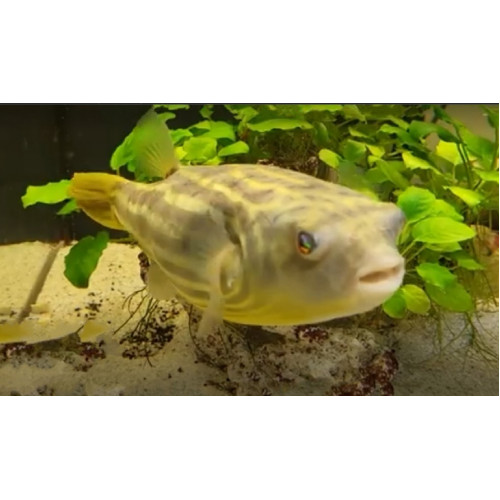
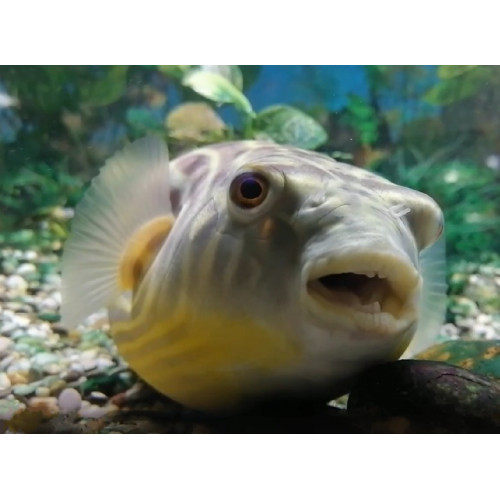
The skin of the Fahaka pufferfish is scaleless, but the head and body are covered with small spines, except for the snout and caudal region. The teeth have a beak-like structure; each jaw consists of two parts fused along the midline and covered with a layer of enamel. The nostrils consist of two fleshy lobes located in front of a folded collar surrounding the opening. Two pairs of non-perforated nasal tentacles. A ventral pouch connects the gill chamber to the esophagus, allowing the fish to inflate its body like a ball.
Features of fish fins
Dorsal spines (total): 2–3; dorsal soft rays (total): 9–10; anal spines: 2; anal soft rays: 7–8. The dorsal and anal fins are short and located far back on the body; the pectoral fins are well developed; pelvic fins are absent; the caudal fin is rounded, and its length averages about 3 times the length of the fish.
Fish coloring
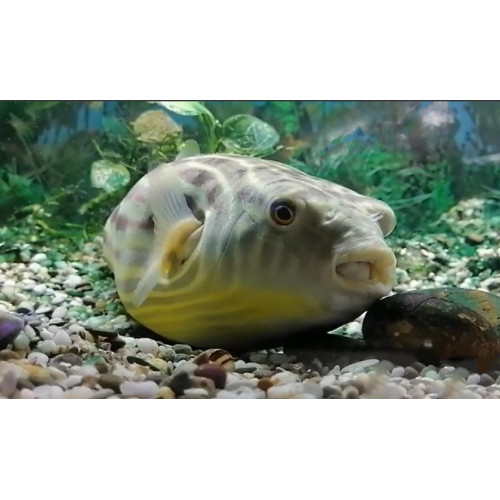
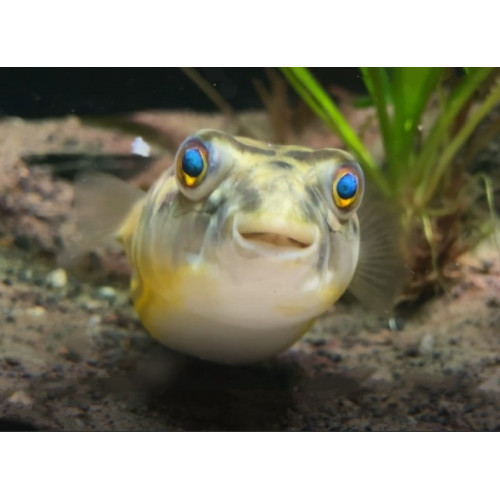
Adults have longitudinal stripes along the sides of the body. Juveniles have red eyespots with black borders.
Distribution
It is distributed in western, eastern, and northeastern Africa. It inhabits the Nile basin, including the White Nile, Lake Turkana, Lake Nasser (Sudan), the Baro River (Ethiopia), the Lake Chad basin, and the Niger, Volta, Gambia, Geba, and Senegal rivers.
Habitat
A tropical demersal (bottom-dwelling) fish that lives in large rivers and other open bodies of water. It inhabits waters with temperatures of +24…+26°C. It lives among stands of aquatic plants.
Size
The total body length reaches 43 cm (17 inches), and weight up to 1 kg (2.2 lbs). In the Nile River, the recorded average lifespan of the Fahaka pufferfish is about five years.
Behavior
When in danger, the Fahaka pufferfish takes air or water into its mouth and inflates, turning into a ball. This helps them escape from predatory fish — not every predator dares to grab a ball that looks nothing like a fish! When the danger passes, they return to their normal appearance.
Food and feeding habits
It feeds mainly on benthic organisms, which may include freshwater mussels and snails.
Reproduction
Researchers AbouelFadl and Farrag measured that the gonadosomatic index of the Fahaka pufferfish increases from April to August. They interpreted this data as indicating the spawning season during this period.
Fishing
It is caught using various methods, depending on the region and water conditions. This fish has commercial value, but primarily in the aquarium trade.
Relationship with a person
It is not an edible fish. These fish contain the dangerous neurotoxin tetrodotoxin in their tissues. Consuming this fish can lead to poisoning, paralysis, and death.
| Classification | |
| Phylum | Chordata |
| Class | Actinopterygii |
| Squad | Tetraodontiformes |
| Family | Tetraodontidae |
| Genus | Tetraodon |
| Species | T. lineatus |
| Features | |
| Conservation status | Least Concern |
| Habitat | Bottom |
| Life span, years | 5 |
| Maximum body weight, kg | 1 |
| Maximum length, cm | 43 |
| Sailing speed, m/s | No information |
| Threat to people | Not edible |
| Way of eating | Predator |
Fahaka pufferfish
Tags: fahaka pufferfish