
Latin name
Perca fluviatilis
Other name
Common perch, redfin perch, big-scaled redfin, English perch, Euro perch, Eurasian perch, Eurasian river perch, hatch, poor man's rockfish.
Identification
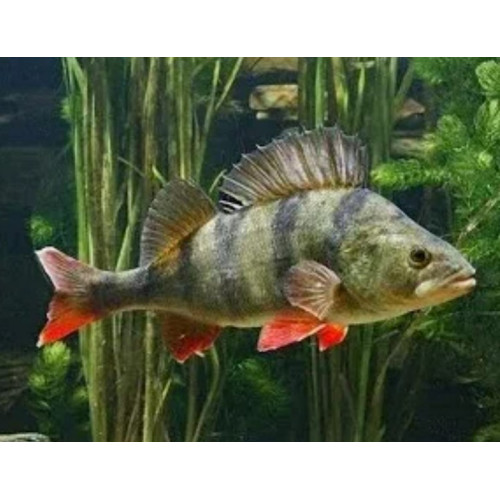
The European perch has a laterally compressed body covered with dense, small ctenoid scales. It has a blunt snout and a slight hump behind the head. The upper jaw usually ends at the vertical line through the middle of the eye. The iris of the eye is yellow. The upper part of the opercle (gill cover) is covered with scales and bears a spine (sometimes double); the preoperculum is serrated. The perch has villiform (brush-like) teeth arranged in rows on the jaws, vomer, and palatine bones; it has no canine teeth. The gill membranes are not fused together. There are 53 to 77 scales along the lateral line. Above the lateral line, there are 7—10 rows of scales; below it, there are 12 to 21 rows. The cheeks are fully scaled, but there are no scales on the caudal fin. Perch fry have delicate scales, but with age, they become extremely tough and hard. The number of vertebrae is 38—44. There are 16—29 gill rakers.
At the beginning of the perch's intestine, there are three blind outgrowths (pyloric caeca). The intestine of the perch is quite short, its length approximately equal to the length of the body. The liver is divided into two parts. The gall bladder is quite large, and the spleen has an elongated shape.
Externally, male European perch are almost indistinguishable from females.
The following minor differences between male and female perch have been identified:
a greater number of scales in the lateral line;
a greater number of spiny rays in the second dorsal fin;
a less deep body;
a larger eye;
a longer base of the anal fin.
The European perch is characterized by high intraspecific variability of morphological traits depending on ecological conditions. As morphometric indicators, the rays in the first dorsal fin and the structure of the skeleton are most often used. The system of non-metric traits of the perch skeleton includes 61 characteristics. Also described are forms of perch, the differences of which include the number and length of gill rakers, the shape of the body and its individual parts, and the number of scales in the lateral line. Furthermore, the pattern of pigmented zones on the fish's body is used to analyze morphometric differences.
Morphological differences in the body structure of perch from different bodies of water are primarily caused by different growth rates. For example, slow-growing perch from Karelian lakes have a shorter caudal fin, a smaller head size, and a deeper body. Fast-growing southern populations (for example, perch from the Volga River delta) have the longest caudal fin, the largest head size, and the smallest eye size. In isolated populations that have lived for a long time in brackish water bodies, significant phenogenetic deviations can be observed.
Features of fish fins
The perch has two dorsal fins located very close to each other, with the first dorsal fin being taller and longer than the second. The first dorsal fin starts above the base of the pectoral fins or slightly in front of them. The pectoral fins are slightly shorter than the pelvic fins. The first dorsal fin of the perch has 12 to 16 spiny rays; the second has 1—4 rigid rays and 12—17 soft rays; the anal fin has 2—3 spiny rays and 7—11 soft rays.
Fish colouring
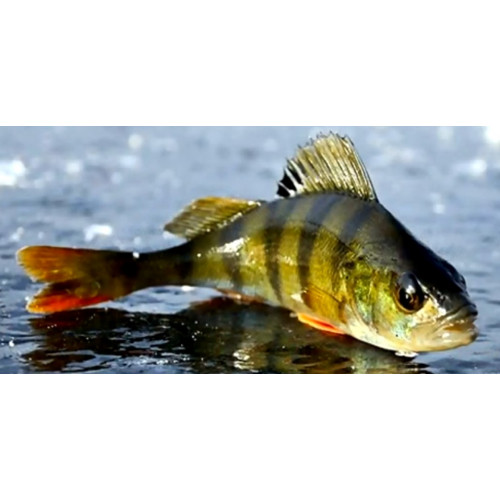
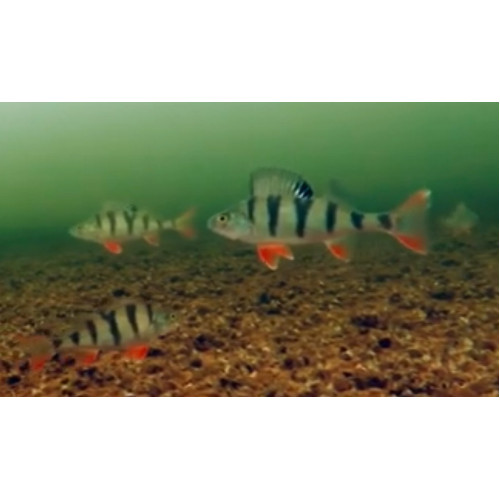
The body of the perch is greenish-yellow in color with black transverse stripes on the sides, of which there can be from 5 to 9; the belly is white. At the tip of the first dorsal fin, there is a black spot, which is a distinctive characteristic of the species. The first dorsal fin is gray, the second dorsal is greenish-yellow, the anal and pectoral fins are yellow, sometimes red, and the pelvic fins are light-colored with a bright red border. The caudal fin is dark at the base and red on the sides and at the tip.
In European perch living on a sandy bottom in clear water, in shallow places, the coloration is light with faintly expressed stripes and spots. In reservoirs with a brown, peaty bottom and brown water, they are colored dark, sometimes almost black, and those living near aquatic plants have a greenish tint.
Distribution
The natural range of this fish species covered almost all of Europe, with the exception of the northern part of Great Britain, the Atlantic coast of Scandinavia, Ireland, the Iberian Peninsula, the Apennines, the southern part of the Balkan Peninsula (south of the basins of the Maritsa and Vardar rivers), the Crimea, the northern regions of the Kola Peninsula, and the Arkhangelsk Oblast of Russia. In addition, the natural range of the perch extended over a significant part of Northern Asia, including the Kolyma basin in the east and the Aral Sea basin in the south, excluding the northern regions, the rivers of the Amur basin, the basins of Lakes Balkhash and Issyk-Kul, the Zeravshan River basin, and the mountainous regions of Transcaucasia. The perch has been recorded in Turkey (for example, in Lakes Durusu and Sapanca), Iran (Anzali Lagoon and the lower reaches of the Sefidrud River), Afghanistan (Amu Darya River), Mongolia, the Lankaran District of Azerbaijan, and Turkmenistan (Lake Yaskhan). It is present in the Syr Darya (up to Kyzylorda) and the Amu Darya, rivers of the Aral Sea basin. Among other rivers of the endorheic basins of Central Asia, it inhabits the Chu (up to the city of Aksu), the Sarysu, the Turgai, the Irgiz, and the Bulgan (Mongolia). In the north, the perch is found up to 74° N latitude and 168° E longitude, and it is present in lakes on the Solovetsky Islands. Closer to the northern boundary of its range, the perch is found more rarely. According to paleontological findings, the European perch previously also inhabited the Amur basin.
The range of the European perch has significantly expanded due to its introduction (sometimes unintentional) into other bodies of water. The perch has appeared in the waters of Spain, Cyprus, the Azores Islands, Morocco, South Africa, China, Australia, New Zealand, and other countries. Most cases of perch dispersal are associated with the activities of the British, who brought it to their colonies for recreational fishing purposes. According to some ichthyologists, the spread of the perch has had negative ecological consequences, in particular, it has adversely affected the abundance of some native fish species.
Habitat
The European perch predominantly inhabits lowland water bodies: rivers, lakes, ponds, and reservoirs, but it is also found in high-mountain lakes (at an altitude of 1000 m). The classification of European rivers by typical ichthyofauna places the perch in the so-called barbel zone and bream zone. In some bodies of water, the perch is the only fish species present. The perch can also live in brackish water, and it is found in coastal areas of seas.
The perch mainly keeps to the coastal, overgrown zone of a water body, as well as artificial or natural obstacles, and prefers areas with abundant aquatic vegetation. It tends to avoid parts of a water body with low temperatures and fast currents; it is absent in the upper reaches of rivers with cold spring water. The favorable pH range is 7.0—7.5, water hardness in German degrees (dH) is 8—12, and water temperature is 10—22 °C.
Within a large water body, the perch can form isolated populations.
Northern populations are characterized by a longer lifespan, later maturation, and lower fecundity.
Size
As a rule, the length of the European perch does not exceed 50 cm, and its weight does not exceed 2 kg, although individual specimens can reach larger sizes. The maximum size of perch in each body of water varies significantly. The average size of an adult perch is 15–20 cm. Studies of perch in Lake Constance have revealed that perch ranging in length from 6 to 31 cm constitute 93 to 97% of the total perch biomass. The maximum recorded lifespan is 23 years. This age was noted for a perch caught in Lake Khövsgöl (Mongolia), measuring 44.7 cm in length and weighing over 2 kg.
The growth rates and timing of sexual maturation of the European perch can vary greatly in different bodies of water. The growth rate of perch is primarily influenced by the climatic characteristics of the water body and the availability of accessible fish prey, which allows for an earlier transition to a predatory lifestyle. Overall, the growth rate of perch is not high. In small bodies of water, as well as in conditions of a poor food supply, the perch grows to 5 cm in its first year and to 20 cm by 6 years. In large lakes, reservoirs, and deltas of large rivers, the perch can reach 12 cm in length by its first year, and a five-year-old can be 35 cm long.
In the Southern Hemisphere (Australia and New Zealand), perch grow faster than in most water bodies in the Northern Hemisphere. Upon transitioning to a predatory lifestyle, the growth rate of perch can accelerate.
The growth rate of perch depends on ecological conditions and can vary significantly from year to year within the same body of water. There is a hypothesis that increased water salinity may increase the growth rate of perch. Studies of perch from Swedish waters have shown that young perch experience seasonal growth spurts in April and June.
Differences in the growth of perch fry within a single population have been noted, meaning some perch grow faster than others.
Behavior
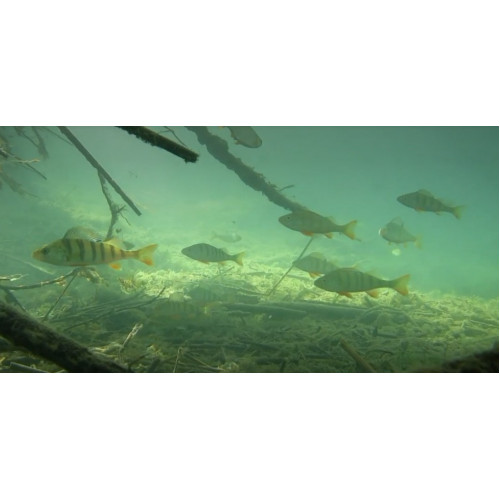
In summer, small perch prefer to stay in backwaters and bays overgrown with aquatic vegetation. During this period, the perch forms small schools (about 10 fish); only in young individuals can schools reach a size of about 100. The perch likes to be near the pilings of destroyed mill dams, large stones, and sunken trees (snags).
Thanks to its greenish protective coloration, perch successfully hunt small fish by ambushing them among aquatic plants. Large perch live in deeper places: pools, holes, often filled with snags, from which they emerge in the morning and evening to hunt. The average swimming speed of a perch is 0.66 m/s. Young perch are characterized by schooling hunting behavior; only the largest individuals begin to hunt alone. The European perch uses a very aggressive hunting style; it actively pursues its prey, sometimes even leaping out of the water after it. Sometimes the perch gets so carried away in pursuit that it may run aground or even beach itself in the process. During an attack, the perch's dorsal fin is erect. Larger perch may lie in wait for their prey in an ambush, similar to a pike or walleye.
The European perch is a crepuscular-diurnal predator that hunts during daylight hours, with peak activity at dawn and dusk. At night, perch activity decreases sharply. The main factor influencing the activity and growth of perch is water temperature. The perch's activity is also influenced by the length of daylight, the composition of its diet, and the oxygen content in the water. The perch exhibits a significant change in the intensity of metabolic processes with both an increase and a decrease in the oxygen content in the water.
In deep lakes during the summer, even large perch tend to stay at shallower depths than in winter; for example, in Lake Constance (with a maximum depth of 254 m), adult perch are mainly observed at depths from 5 to 25 m in the summer.
During the summer period, the perch prefers places where the decrease in oxygen levels in the water is less pronounced. It has been established that from July until the autumn cooling, the thermocline has a great influence on the vertical distribution of perch in a water body. In summer, the perch may undertake short feeding migrations. With the onset of winter, the perch returns to rivers, which have more favorable conditions.
In autumn, perch gather in large schools (numbering up to a thousand or more individuals in large bodies of water), which migrate to deeper and more open areas. In a reservoir during the winter, perch concentrate in the riverbed areas, bounded by the former banks of the dammed river. During the cold season, the perch stays in the bottom part of the water body. The depth at which perch are located in winter can be quite significant; for example, in Lake Constance, most perch gather at depths from 42 to 69 m. In winter, perch are also active during daylight hours, with increased activity during twilight hours and no activity at night. In Lake Constance, a surge in perch activity has been recorded around midnight, when perch rise en masse from the bottom part into the water column (to a depth of approximately 20 m from the water surface).
European perch use a short drumming sound as a danger signal during their hunting of fry.
Food and feeding habits
Initially, perch fry feed on zooplankton; as they grow, they switch to feeding on benthic organisms, and upon reaching adulthood, they begin to hunt juvenile fish (primarily cyprinids and percids). The perch typically starts feeding on fry in its second year of life, but in some bodies of water, it may start in its first year upon reaching 4 cm in length. Most often, the transition to piscivory (fish consumption) coincides with the onset of sexual maturity. In some bodies of water, the transition to a predatory lifestyle occurs much later (in the northern lakes Chyorny Sor, Tormemtor, and Svetloye in the Khanty-Mansi Autonomous Okrug, this happens at the age of 5–8 years). With age, the perch switches to hunting larger and more mobile prey.
Based on its feeding habits, this species is classified as a facultative predator, meaning it is a predatory fish but also consumes a large amount of other animal food. In some bodies of water, the perch may consume zooplankton and benthos throughout its life, without switching to feeding on fry. This same behavior is characteristic of the coastal perch.
The perch primarily consumes slender-bodied fish. The most common prey of adult perch are fish of low commercial value: sticklebacks, minnows, and juvenile roach. Secondary food items among fish include bleak, ruffe, gobies, tadpole fish (Benthophilus), juvenile pike-perch (zander), Volga pike-perch (bersh), crucian carp, and white bream (silver bream). In the rivers of New Zealand, the main food item has become the local small fish Gobiomorphus cotidianus.
Cannibalism is characteristic of the perch: adults often eat young perch. Cannibalism most frequently occurs in autumn, when young perch leave the coastal zone, moving to deeper areas for the winter. In the summer, young perch are very rarely found in the stomachs of adults. Cannibalism is most characteristic of water bodies inhabited exclusively by perch. The diet of adult perch also often includes insect larvae, frogs, and crayfish. Algae, pieces of bark, and small stones are also found in perch stomachs. It is assumed that perch ingest these accidentally along with benthic organisms, although there are versions that these incidental objects are necessary to stimulate digestion.
During prolonged starvation, the perch loses weight faster and dies sooner than other freshwater predators.
Reproduction
Spawning in the European perch occurs once a year at approximately the same time. The main factor determining the timing of spawning is water temperature. In the Northern Hemisphere, spawning occurs in early spring, immediately after the ice breaks up, at a water temperature of 7–8 °C; in southern regions, it occurs in February–April; in northern regions, in May–June. In Australia, spawning occurs in August–October; in New Zealand, in September–November. Large individuals begin spawning later than small ones.
Before spawning, the perch may undertake migrations; perch inhabiting desalinated areas of seas move into rivers to spawn. In reservoirs and lakes, perch migrate to the littoral (shallow coastal) zone. In some lakes, part of the perch population may go to spawn in rivers, while another part remains to spawn in the lake. Males arrive at the spawning site earlier than females.
Fecundity, depending on the size of the female, ranges from 12 to 300 thousand eggs. The number of eggs increases with the length of the fish; females of the perch living in warmer climates also have more eggs. In contrast to many other fish, no external changes are observed in the European perch during spawning. The spawning period for perch is not long and lasts on average 4–5 days (maximum up to 9).
During spawning, the female is accompanied by several males, the number of which can reach up to 25. Spawning occurs once, and during spawning, the female perch lays her eggs in the form of long (up to 1 m) mesh ribbons of gelatinous substance on last year's vegetation, flooded bushes and snags, and fishing nets, while the accompanying males fertilize them. In exceptional cases, in the absence of such objects, the female perch may spawn on a sandy or muddy bottom at a depth of 0.2 to 1.5 m. The size of the ribbon depends on the size of the female. Perch eggs are highly hydrated (water content — 56%), with a diameter of 2–2.5 mm (sometimes 1 mm). At the end of spawning, unlike other species of percid fish, the female never retains any eggs. Laying eggs on vegetation and other objects, as well as the low palatability of the eggs for other fish species, helps ensure high survival rates.
In reservoirs, spawning is often longer; in addition, two spawning periods are sometimes observed, the second of which occurs at a higher water temperature (10–18 °C). Unlike the pike-perch (zander), the male perch does not guard the eggs.
Fishing
In some fisheries, the European perch is considered a rough or undesirable fish, a food competitor to more valuable fish species. In others, the perch is one of the primary targets of commercial fishing.
Commercial fishing during the open-water period is carried out using pair trawls and midwater trawls, as well as gillnets; during the ice-covered period, exclusively with gillnets. Perch most often dominate commercial catches in the spring and autumn periods.
This species is one of the popular targets for recreational fishing. It is less afraid of noise than other fish species. This fish is known for its voracity and boldness. It is caught using a variety of tackle: float rods, spinning rods, bottom rods, trolling gear, fly fishing gear, float fishing tackle (rigs like "circles"), and vertical jigging. The most popular of the methods listed above are float rod fishing and spin fishing (spinning).
Relationship with a person
The meat of the perch has good taste qualities, and moreover, the perch has relatively few bones. Perch can be consumed fried, boiled, smoked, baked, and dried. Perch is also used for preparing canned fish and fillets. Perch is considered a dietary dish; the energy value of 100 g of perch meat is 82 kcal. When frozen at −18 °C, perch fillet retains its taste qualities for 3–4 months.
Despite its tasty meat, many people dislike the European perch because of its spiny rays and spines, as well as its dense scales, which are difficult to clean.
| Classification | |
| Phylum | Chordata |
| Class | Actinopterygii |
| Squad | Perciformes |
| Family | Percidae |
| Genus | Perca |
| Species | P. fluviatilis |
| Features | |
| Conservation status | Least Concern |
| Habitat | Pelagic |
| Life span, years | 23 |
| Maximum body weight, kg | 2 |
| Maximum length, cm | 50 |
| Sailing speed, m/s | 0,66 |
| Threat to people | Edible |
| Way of eating | Predator |
European perch
Tags: european perch