

Latin name
Gambusia holbrooki
Other name
Bore-drain fish, Eastern gambusia, Eastern mosquito fish, Eastern mosquitofish, Gambies, Gambusia, Mosquitofish, Plague minnow, Starling's perch, Top minnow.
Identification
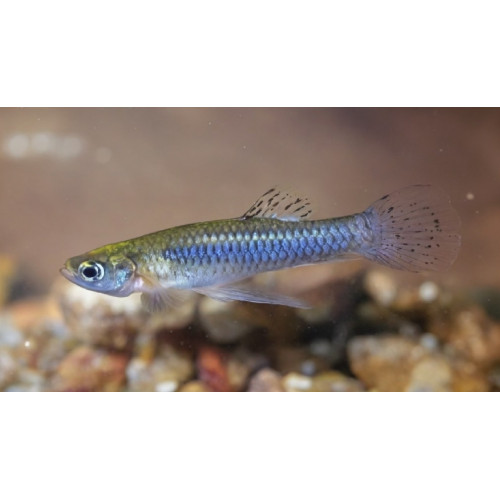
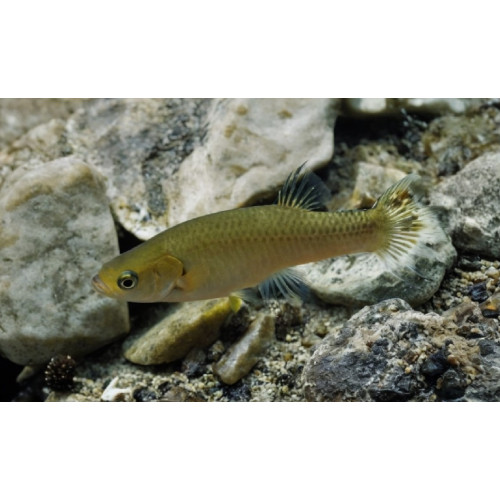
The body of the Eastern mosquitofish is moderately elongated, not tall, and laterally compressed. It is covered with relatively large scales that extend onto the head (to the anterior edge of the eyes and below them). The mouth is small, oblique, and superior due to the elongated and upward-directed lower jaw.
Features of Fish Fins
The first two rays of the anal fin are thin and small; rays 3, 4, and 5 are highly elongated and modified into a specialized copulatory organ—the gonopodium. In males, the posterior edge of the segments of the third anal fin ray is serrated.
Fish Coloration
The back and sides of the Eastern mosquitofish are greenish-gray, grayish-brown, or metallic gray. The belly is milky- or silvery-gray, often with a dark spot above the pelvic fins. A narrow dark stripe runs along the midline of the back from the head to the dorsal fin, sometimes extending onto the caudal peduncle. A dark spot is present below each eye. The dorsal and caudal fins have 2–3 dark stripes, while the remaining fins are colorless.
Distribution
Its natural range encompasses freshwater bodies in North America from New Jersey to Alabama. Due to its dietary specificity (tropism for mosquito larvae), the fish has been introduced to water bodies in many regions worldwide. It was brought to Europe (Spain) in 1921 and in 1925 from Italy to Sukhumi (Georgia), from where it was dispersed throughout the Caucasus, Central Asia, and Ukraine. It has become naturalized and is now found in Crimea in the Salhir River basin, the Simferopol Reservoir, and has also been recorded near Yalta and other locations.
Habitat
It is a freshwater, lake- and river-dwelling, schooling resident fish characterized by high plasticity. It adapts well to various environmental conditions, tolerates significant water pollution and salinization, and withstands wide fluctuations in water oxygen content. It inhabits areas with stagnant or slow-flowing water, primarily in shallow coastal zones up to 1–1.5 m deep, with sandy-silt or silty substrates and well-developed aquatic vegetation.
Size
The maximum body length of females is 6 cm, typically 3–4 cm, with a weight of 4.5–5.0 g, usually 1–2 g. The maximum body length of males is 3.5 cm, typically 2.5 cm, with a weight of 1.5 g, usually 0.15–0.3 g. Lifespan is up to 3 years.
Behavior
The Eastern mosquitofish nips the tails and fins of freshwater fish and tadpoles and consumes the eggs of other fish and amphibians, thereby significantly reducing their populations.
Food and Feeding Habits
A highly voracious species, it feeds primarily on invertebrates from coastal vegetation: oligochaete worms, small crustaceans, insect larvae and pupae. It also consumes plant matter (blue-green, diatom, green, and other algae), as well as fish eggs and fry.
Reproduction
It reaches sexual maturity as early as 1–13 months of age; females are larger than males. Reproduction begins at a water temperature of 15–18°C and lasts from April to November. Fertilization is internal. Due to its live-bearing nature, a single female can have 4–5 or more broods per vegetative period and can produce up to 350–500 fry per season. At a water temperature of 25–30°C, a female gives birth to fry every 25–30 days.
Fishing
It has no commercial value.
Relationship with Humans
It was introduced into aquatic biocoenoses to control malaria mosquito larvae. It thrives in aquariums.
| Classification | |
| Phylum | Chordata |
| Class | Actinopterygii |
| Squad | Cyprinodontiformes |
| Family | Poeciliidae |
| Genus | Gambusia |
| Species | G. holbrooki |
| Features | |
| Conservation status | Least Concern |
| Habitat | Neritic |
| Life span, years | 3 |
| Maximum body weight, kg | 0,002 |
| Maximum length, cm | 6 |
| Sailing speed, m/s | No information |
| Threat to people | Not edible |
| Way of eating | Planktonophage |
Eastern mosquitofish
Tags: eastern mosquitofish