
Latin name
Chondrostoma nasus
Other name
Nase, sneep.
Identification
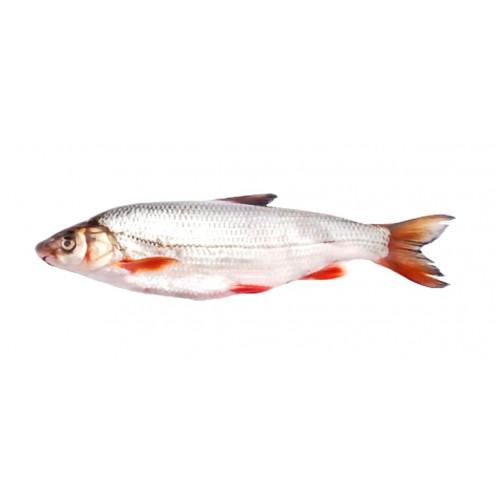
A swift river fish with a unique mouth structure, known for its schooling behavior and specific feeding habits. The common nase has a streamlined body, perfectly adapted for life in fast-flowing water. It is elongated and slightly compressed laterally, providing the fish with high maneuverability and speed. The back is slightly raised, and the belly is flattened. The scales are small; along the lateral line, there are 52–66 scales (usually 60–63).
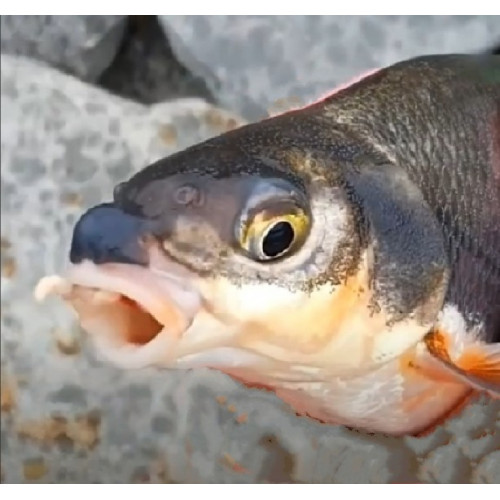
The most recognizable feature is the structure of its mouth. The mouth is located on the underside of the head (inferior mouth) and has the shape of a transverse slit. The lower jaw is covered with a sharp horny (cartilaginous) sheath that works like a scraper or grater. With this "scraper," the fish scrapes algae (periphyton), encrustations, and detritus — its primary food — from the bottom and off underwater objects.
The Latin genus name Chondrostoma comes from the Greek chondros (cartilage) and stoma (mouth), referring to the cartilaginous edge of the lower jaw.
Features of fish fins
The dorsal fin is single, rather long, and located approximately in the middle of the back. It consists of three unbranched and 8–10 branched soft rays. When folded, it lies flat against the back; while swimming, it helps the fish maintain stability.
The anal fin is located on the underside, closer to the tail, opposite the rear part of the dorsal fin. It has 3 unbranched and 9–12 branched rays.
The caudal fin is powerful, well-developed, and deeply forked. It has 19–21 branched rays (all of which are soft; there are no rigid rays).
The pectoral fins are paired, located just behind the gill covers, on the sides of the body. Each pectoral fin consists of one unbranched and 14–17 branched soft rays.
The pelvic fins are also paired, located on the belly approximately in the middle of the body. Each has 2 unbranched and 8–9 branched soft rays.
All fins lack spiny rays. In males, the dorsal and anal fins are more developed and larger than in females of the same age.
Fish colouring
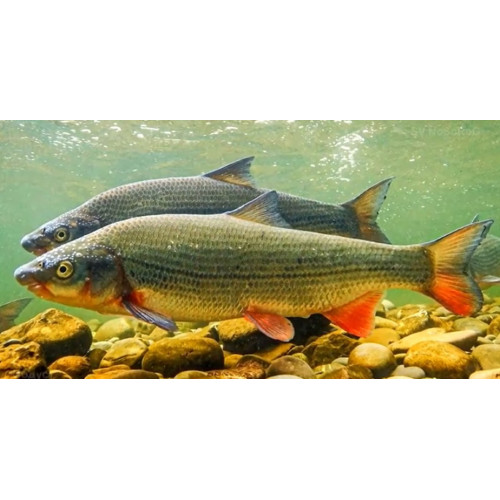
The back is dark gray or greenish-black, the sides and belly are silvery-white. During the spawning season, males become brighter: they develop orange-yellow spots at the corners of the mouth, on the gill covers, and at the base of the pectoral fins, and a dark stripe may appear along the sides. The pelvic and anal fins have a reddish or yellowish-orange tint; the pectoral fins are also reddish at the base. The dorsal and caudal fins are gray or smoky. When the abdominal cavity is opened, distinct black layers are visible along the walls. The cause of this phenomenon has still not been fully explained from a biological perspective.
Distribution
A typical river dweller that does not occur in standing waters. Its natural range includes rivers in the basins of the Black Sea (Danube, Dnieper, Dniester, Southern Bug), the Baltic Sea (Neman, Vistula, Oder), and the North Sea (westward to the Meuse River). It is not found in the Asian part of Russia. It has been introduced into some rivers in France (Rhône, Loire, Seine) and Italy (Isonzo/Soca River).
Habitat
A demersal (bottom-dwelling), schooling, rheophilic (current-loving) species.
Preferred biotopes: rivers with moderate to fast currents, with rocky, pebbly, or hard clay bottoms. Adults stay in deeper areas, often near bridge pilings, behind rocks, and in places with eddies.
Size
Maximum size: up to 50 cm (20 inches). Maximum weight: up to 1.5–1.6 kg (3.3–3.5 lbs). Maximum age: up to 15 years.
Behavior
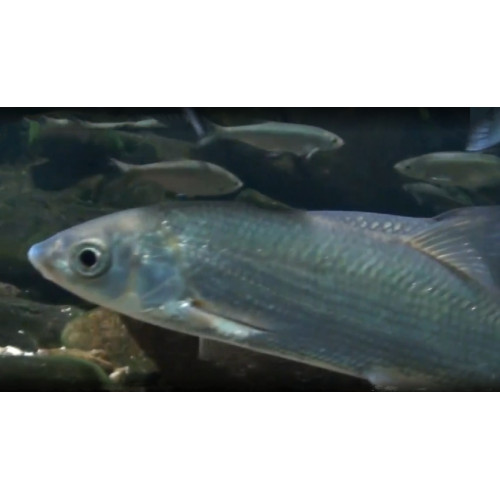
Schooling fish. They form groups, sometimes numbering several hundred individuals, often separated by age. In winter, adults gather in dense aggregations in lower river sections, while juveniles retreat to backwaters or hide in bank hollows. For spawning, they undertake short migrations (up to several tens of kilometers) upstream to tributaries with suitable spawning grounds. Thanks to their streamlined body shape, they can develop high speed and successfully withstand strong currents.
Food and feeding habits
The feeding behavior of the common nase changes with age. Larvae and juveniles feed on small invertebrates (zooplankton, small crustaceans). Adults feed on periphyton (encrustations on rocks), filamentous algae, detritus, as well as the eggs of other fish and small benthic invertebrates.
Reproduction
Spawning occurs once a year, in April–May, when the water temperature reaches about 10–15°C (50–59°F). They spawn in fast-flowing water on shallow, rocky, and pebbly areas (riffles). The female lays between 12,000 and 100,000 eggs. The eggs are adhesive and stick to rocks. The incubation period is about 10 days. The hatched larvae are afraid of light and hide under rocks. During the first two months, the fry lead a pelagic lifestyle, after which they settle to the bottom. Sexual maturity is reached at 4–5 years of age.
Fishing
This fish species has no significant commercial value, although its meat is considered tasty (but bony). It is a popular target for sport and recreational fishing. It is caught with float rods and bottom rods, often using a trotting technique.
Relationship with a person
In 2023, the species Chondrostoma nasus was given the conservation status of "Near Threatened" on the IUCN Red List.
The main threats to this species include:
River regulation through dams, which block migration routes to spawning grounds.
Destruction of spawning grounds caused by channel clearing, dredging, and siltation of rocky bottoms.
Water pollution, as the common nase is sensitive to water quality.
Competition in areas where it has been introduced, where it may displace native fish species such as Parachondrostoma toxostoma in France.
| Classification | |
| Phylum | Chordata |
| Class | Actinopterygii |
| Squad | Cypriniformes |
| Family | Leuciscidae |
| Genus | Chondrostoma |
| Species | C. nasus |
| Features | |
| Conservation status | Least Concern |
| Habitat | Bottom |
| Life span, years | 15 |
| Maximum body weight, kg | 1,6 |
| Maximum length, cm | 50 |
| Sailing speed, m/s | No information |
| Threat to people | Edible |
| Way of eating | Planktonophage |
Common nase
Tags: common nase