
Latin name
Alburnus alburnus
Other name
Bleak
Identification
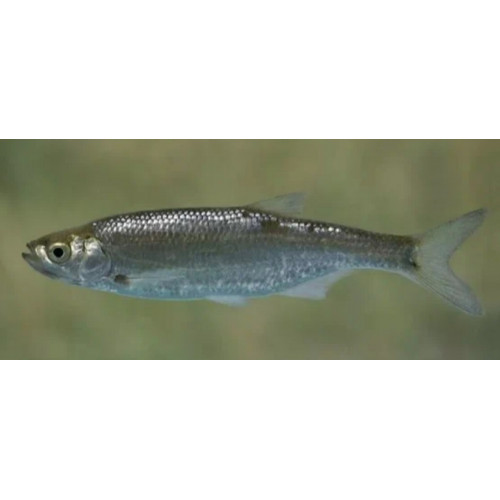
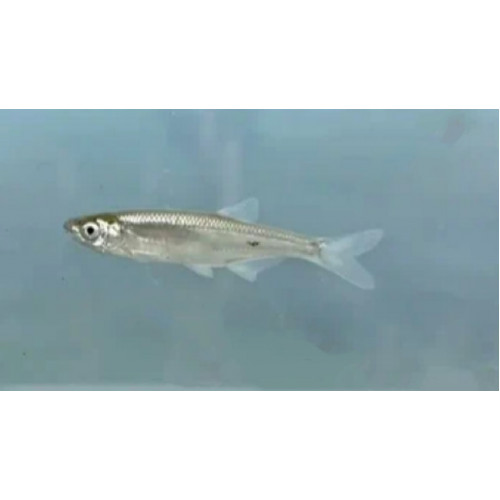
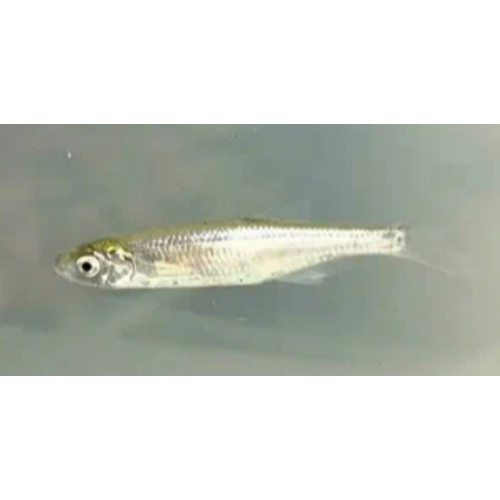
The body of the common bleak is elongated, strongly compressed laterally, with an almost straight dorsal line and a slightly convex belly. This gives the fish a streamlined, swift shape. The scales are small, delicate, cycloid, and very easily detached. The main distinguishing feature is the superior mouth. The lower jaw projects noticeably forward and is curved upward, with the mouth opening directed obliquely upward. This is an adaptation for capturing food from the water surface. Between the pelvic fins and the anal opening there is a pointed, scaleless, skin-covered keel.
Features of fish fins
The fins have a typical cyprinid structure, but with one important feature in the anal fin that is used for precise species identification. They have a single dorsal fin, which contains two to four spiny (unbranched) rays and seven to nine soft (branched) rays, so the total number of rays in it ranges from nine to thirteen. They also have a single anal fin, which has three spiny rays and fourteen to twenty soft rays, but here there is an important nuance: the last two soft rays are often counted as "one and a half" because they attach to a single bony base, and ichthyologists record this as 14–20.5. The caudal fin is forked (deeply divided) and consists of nineteen rays. The pectoral fins are paired; the exact number of rays in them is not known, but for most cyprinids, there are thirteen to seventeen. The pelvic fins are also paired, but the exact number of rays in them is likewise not known.
Fish coloring
The coloration is typical of pelagic fish — camouflaging from above and below. The back is dark, with a greenish-blue or bluish-gray tint. The sides and belly are bright silvery, with a mirror-like sheen. This coloration makes the fish inconspicuous both to predators from above (blending with the dark bottom) and from below (blending with the bright sky). The dorsal and caudal fins are dark gray, sometimes with a dark edge. The pectoral, pelvic, and anal fins are light, whitish or yellowish.
Distribution
One of the most abundant and widespread fish species in European waters. It is found throughout most of Europe (from the Pyrenees in the west to the Ural Mountains in the east), as well as in the basins of the Black, Caspian, Azov, and Baltic Seas. It is absent from Scandinavia north of 67°N, Ireland, Italy, and most of the Balkan Peninsula.
Habitat
A freshwater pelagic species. It prefers open waters of large rivers and lakes with a gentle current. It stays primarily in the upper and middle water layers. It avoids heavily vegetated waters covered with duckweed, as it is sensitive to oxygen levels. In winter, it descends to deep holes.
Size
Size and weight can vary greatly depending on habitat conditions and region. This fish is known for its ability to adapt quickly, so it grows larger in big rivers and reservoirs than in small streams. In most water bodies, the length is 12–15 cm (4.7–5.9 inches). The maximum size this fish can reach is up to 25 cm (10 inches). Such large specimens are considered trophy fish. The standard weight for a fish 12–15 cm long is about 40 grams (1.4 ounces). The largest officially recorded weight is 60 grams (2.1 ounces). Average lifespan is 5–6 years, with a maximum of up to 8–10 years.
Behavior
A typical schooling fish. It forms large aggregations, especially in the open expanses of reservoirs and lakes. Very active and skittish.
Food and feeding habits
An active consumer of plankton and insects, with feeding habits that change with age. Main diet: zooplankton (small crustaceans, daphnia, cyclops), as well as phytoplankton. Thanks to its superior mouth, the fish is excellent at collecting falling insects (mosquitoes, midges, flies) and their larvae from the water surface. It is known for an interesting hunting technique — the common bleak can jump out of the water or knock insects from above the water using its tail, by lying flat and striking the surface. Despite its small size, large individuals may eat the eggs of other fish and even fry, exhibiting elements of predation.
Reproduction
Spawning occurs during the warm period — from late May to July (even as late as August), when the water temperature ranges from +12 to +20°C (54–68°F). Spawning is fractional — the female lays eggs in 2–4 batches at intervals of 10–15 days. This increases offspring survival. Fecundity ranges from 3,500 to 11,000 eggs. The eggs are small and adhesive. Females attach them to aquatic plants, stones, and submerged branches in shallow water (depth 0.1–0.6 m / 4–24 inches). Sexual maturity is reached at 2–3 years of age, at a length of 6–10 cm (2.4–4 inches).
Fishing
This species has no significant commercial value due to its small size, but it is important in several respects. It is one of the best baits for catching predatory fish (pike, zander, perch, catfish, asp).
Relationship with a person
Historically, the scales of the common bleak were used to produce "pearl essence" (Essence d'Orient). The silvery pigment (guanine) from the scales was precipitated and used to coat glass beads, creating imitation pearls. The meat of these fish is considered tasty, but due to the abundance of small bones, it is rarely used in cooking.
| Classification | |
| Phylum | Chordata |
| Class | Actinopterygii |
| Squad | Cypriniformes |
| Family | Leuciscidae |
| Genus | Alburnus |
| Species | A. alburnus |
| Features | |
| Conservation status | Least Concern |
| Habitat | Pelagic |
| Life span, years | 10 |
| Maximum body weight, kg | 0,6 |
| Maximum length, cm | 25 |
| Sailing speed, m/s | No information |
| Threat to people | Edible |
| Way of eating | Planktonophage |
Common bleak
Tags: common bleak