
Latin name
Campylomormyrus curvirostris, gnathonemus curvirostris, campylomormyrus rhynchophorus.
Identification
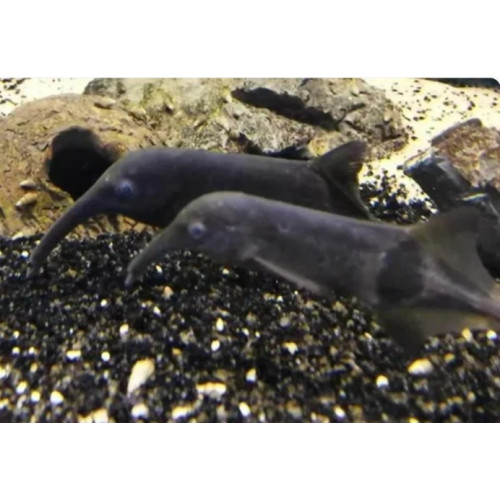
The snout of Campylomormyrus curvirostris is highly elongated and curved downward like a trunk, with a small terminal mouth and a short, mobile barbel on the lower lip. However, the length and curvature of the snout vary greatly among individuals. The teeth are conical and present on both jaws. The scales are small, often covered with a thick layer of mucus. The lateral line consists of 75 to 95 scales.
Features of Fish Fins
The dorsal fin has 26–34 soft rays, and the anal fin has 29–37 soft rays.
Fish Coloration
The anterior half of the body, the caudal peduncle, and the fins are more or less uniformly dark. On the posterior half of the body, there is a dark, vertically oriented elliptical band, bordered anteriorly and posteriorly by narrow light bands. The anterior light band runs from the origin of the dorsal fin to the origin of the anal fin and does not extend onto the fins. These bands are most contrasting in juveniles, becoming less noticeable with growth and eventually disappearing completely in the largest adult specimens.
Distribution
It inhabits Africa in the Zaire River (Congo River) and major rivers within its basin, as well as the Sanaga River.
Habitat
It is a benthic freshwater fish. Within its range, this fish is quite numerous but not uniformly distributed. There is a large section in the middle reaches of the Zaire River where it is absent, likely due to the lack of rocky or stony bottom substrates in that part of the channel.
Size
The total body length of these fish reaches up to 45 cm.
Behavior
Campylomormyrus curvirostris stays near rapids and in sections of rivers with stony or rocky bottoms. It is not found in lakes.
Food and Feeding Habits
It feeds on benthic larvae of various insects: black flies (simuliids), non-biting midges (chironomids), caddisflies, and mayflies.
Reproduction
The eggs of Campylomormyrus curvirostris contain yolk and are slightly sticky. Their diameter ranges from 2.3 to 3.0 mm. The larvae hatch on the 3rd day and begin feeding on the 11th day.
Fishing
This species is not commercially important.
Relationship with a person
Used in aquariums.
| Classification | |
| Phylum | Chordata |
| Class | Actinopterygii |
| Squad | Osteoglossiformes |
| Family | Osteoglossiformes |
| Genus | Campylomormyrus |
| Species | C. curvirostris |
| Features | |
| Conservation status | Least Concern |
| Habitat | Bottom |
| Life span, years | No information |
| Maximum body weight, kg | No information |
| Maximum length, cm | 45 |
| Sailing speed, m/s | No information |
| Threat to people | Not edible |
| Way of eating | Bentophage |