
Latin name
Lampetra planeri
Other Names
The brook lamprey is also known as the European brook lamprey and western brook lamprey. Its scientific name, Lampetra planeri, was given by Bloch in 1784. The species is also known by the synonym Petromyzon planeri. The genus name Lampetra comes from the Latin "lambo" (to lick) and "petra" (rock or stone), referring to its suctorial behavior. The species name honors German physician Johann Jacob Planer, who supplied the holotype. In different languages, it is called mihule potoční (Czech), bæklampret (Danish), beekprik (Dutch), ojasilm (Estonian), pikkunahkiainen (Finnish), Bachneunauge (German), lamproie de ruisseau (French), lampreda minore (Italian), and минога ручьевая (Russian).
Identification
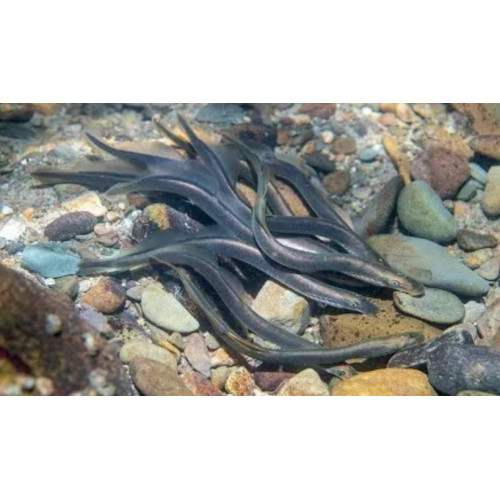
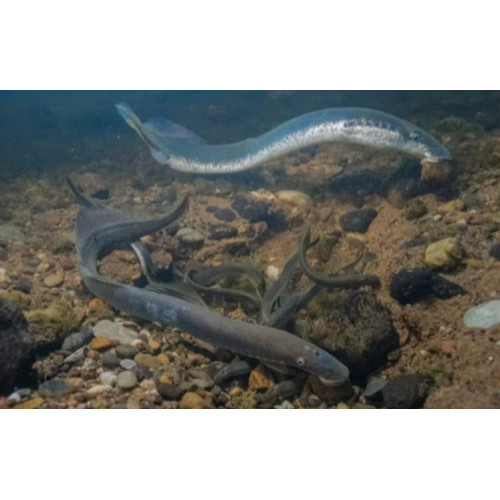
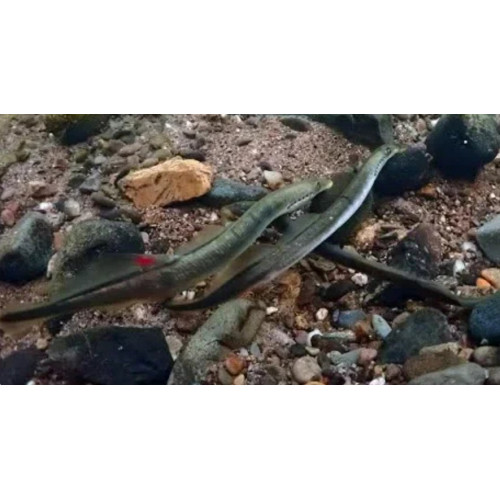
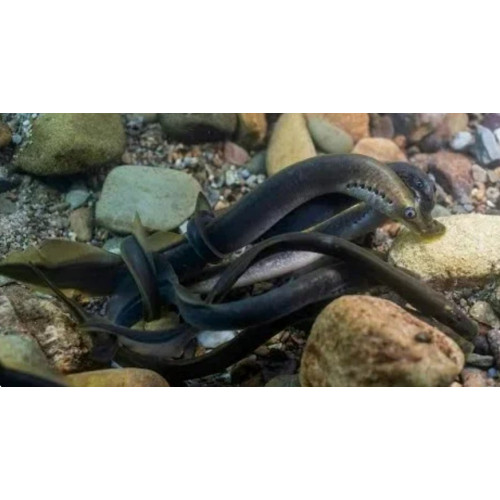
The brook lamprey has an elongated, eel-like (anguilliform) body that is completely scaleless. It is the smallest lamprey found in Europe. A key identifying feature is the circular sucking disc instead of jaws, which is filled with blunt teeth. The species has a single nostril and seven small gill openings on each side behind the eye. The dorsal head profile is clearly concave. Diagnostic features include: two dorsal fins that are in contact in mature adults, poorly developed fins, and the absence of paired fins (pectoral and pelvic fins are absent). The caudal fin is spade-like in shape. The lateral line neuromasts are unpigmented.
Features of Fish Fins
The brook lamprey has two dorsal fins that are in contact with each other in mature adults. This feature distinguishes it from the closely related river lamprey (Lampetra fluviatilis), whose dorsal fins are more separated. All fins lack spines and soft rays (total dorsal spines: 0; total dorsal soft rays: 0; anal spines: 0; anal soft rays: 0). The caudal fin is pointed and spade-like. An adipose fin is absent. Paired fins (pectoral and pelvic fins) are entirely absent. This fin structure is typical of all lamprey species.
Fish Colouring
The colouration of the brook lamprey varies depending on age and season. Adults typically have a blue-green or dark greyish back, yellowish flanks, and a white ventral portion. The dorsal and caudal fins are yellowish. In preserved specimens, the dorsal and lateral aspects are grayish, while the ventral surface is whitish. Some specimens display a prominent dark blotch at the apex of the second dorsal fin. The iris is yellow. In spring, the colouration is typically darker on the back and yellowish on the belly. Larvae are yellowish-brown and lack pigmentation on the ventral region.
Distribution
The brook lamprey is widely distributed throughout Europe. Its range extends from Great Britain north to the Scottish highlands, and rivers draining to the North Sea north to Scotland and about Stavanger (Norway). It is found in the Baltic Sea basin, and the Atlantic as far south as the Adour drainage in France and Spain. Isolated populations exist in Portugal (Sado, Tagus, and Douro drainages) and in the Mediterranean basin in France and western Italy (south to about the Cilento drainage). It is locally present in Ireland, the upper Volga, the upper Danube and some of their tributaries, and the Pescara drainage on the Adriatic coast of Italy. In Spain, only two populations are known: in the Ugarana river basin (Navarre) and the Deva-Cares river (Cantabria-Asturias).
Habitat
This species is a freshwater, demersal fish that lives exclusively in freshwater environments. It is typically found in the lowland, piedmont, and montane zones in clear, well-oxygenated brooks and rivers. It prefers the middle and upper reaches of small streams and rivers, and occasionally occurs in lakes. Larvae lie buried in the substrate (detritus-rich sands or clay sediments), while adults live in the open water. The species prefers water temperatures between 1°C and 15°C and is found at depths of a few centimeters to 0.8 meters.
Size
The brook lamprey can reach a maximum total length of 20.5 cm TL, but reproductive adults typically measure between 8.6 and 17.0 cm TL and usually 12–16 cm TL. The maximum reported age is 7 years.
Behavior
The brook lamprey is a non-migratory, freshwater species that does not undertake long migrations. Larvae live buried in soft sediment for about 5 to 6 years as blind filter feeders (ammocoetes). They then undergo metamorphosis in the fall, developing eyes and a sucking disc, while the intestinal tract degenerates. Adults are non-feeding and live for only about six months, just long enough to spawn. The species is a communal spawner: both sexes participate in constructing a nest (redd) in gravel or sandy riverbeds. Adults die shortly after spawning. The species is potamodromous, meaning it migrates within freshwater systems.
Food and Feeding Habits
The brook lamprey is a filter-feeding species during its larval stage: ammocoetes feed on detritus, organic matter, and microscopic organisms from the water and mud. Adults are non-feeding and do not consume any food during their brief adult life. Unlike parasitic lamprey species, the brook lamprey does not have a parasitic phase and does not feed on other fish.
Reproduction
The brook lamprey is a gonochoristic species (separate sexes) with external fertilization. Spawning occurs once in a lifetime, typically in spring and early summer (from April to July, depending on location) at water temperatures of 10–16°C. Both sexes participate in building nests (redds) in gravel or sandy riverbeds, removing stones with their oral discs. The female attaches to a rock at the upstream end of the nest, while the male attaches to the back of her head, wraps his tail around her, and through muscular contraction assists in egg extrusion. They vibrate vigorously for a few seconds, releasing gametes and disturbing the substrate, which partially buries the fertilized eggs. Fecundity is estimated at several thousand eggs per female (up to 100,000 for some species). The eggs are about 2 mm in diameter, adhesive, and hatch after 3–4 days. Larvae are blind and have no teeth. Adults die after spawning. Larval life lasts about 5 to 6 years, with the smaller individuals of the latter year class delaying metamorphosis by one year.
Fishing
The brook lamprey is rarely fished due to its small size and the mediocre quality of its meat. It is of minor commercial importance. The larvae are sometimes utilized as bait by anglers.
Relationship with a Person
The brook lamprey is not a threat to humans and is classified as harmless. However, it is not recommended to consume it as food, and in many sources, it is considered inedible. The main reason is the toxic mucus covering the body of this fish. The skin glands of the lamprey secrete mucus that contains a thermostable poison. This means that the toxin is not destroyed by heating during boiling or frying. The entry of this poison into the gastrointestinal tract can cause severe inflammation and serious poisoning. For example, there are known cases of people being hospitalized after consuming soup made from this fish. The species is of limited direct importance to humans as a fishery resource, but it is valued as a bioindicator for assessing the health of freshwater ecosystems. The species is listed as Least Concern (LC) on the IUCN Red List, but it faces threats including habitat destruction (such as river channelization), water pollution, and barriers to migration. In Spain, it is considered Critically Endangered. In other parts of Europe, it has declined in some areas. The species requires clean gravel beds for spawning and soft marginal silt or sand for larvae, making it sensitive to habitat degradation.
| Classification | |
| Phylum | Chordata |
| Class | Petromyzontida |
| Squad | Petromyzontiformes |
| Family | Petromyzontidae |
| Genus | Lampetra |
| Species | L. planeri |
| Features | |
| Conservation status | Near Threatened |
| Habitat | Bottom |
| Life span, years | 7 |
| Maximum body weight, kg | No information |
| Maximum length, cm | 20,5 |
| Sailing speed, m/s | No information |
| Threat to people | Not edible |
| Way of eating | Bentophage |
Brook lamprey
Tags: brook lamprey