
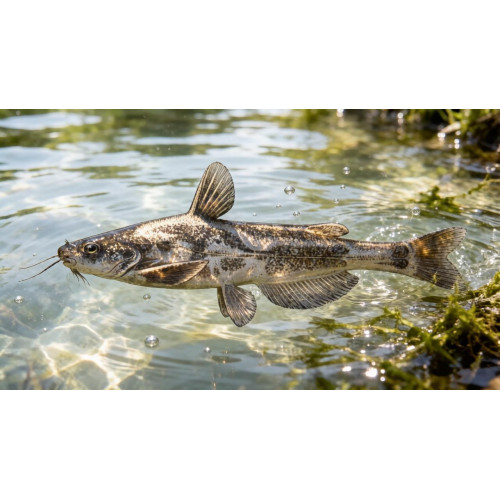
Latin name
Tachysurus brashnikowi
Other Names
Brazhnikov's catfish is also known as Braznikov's catfish in English. Its scientific name, Tachysurus brashnikowi, was given by Berg in 1907. The genus name Tachysurus comes from the Greek words "tachys" (quick) and "oura" (tail). The species is named in honour of Vladimir Konstantinovich Bražnikov (1870–1921), a Russian zoologist, ichthyologist and entomologist who lived in Tokyo for many years. The species is also known by the synonym Liocassis brashnikowi.
Identification
Brazhnikov's catfish belongs to the family Bagridae (bagrid catfishes). The species is a demersal fish, meaning it lives on or near the bottom of water bodies. Specific information on morphological features, such as fin rays, the number of barbels, and the exact body shape, is unknown. However, like other members of the family Bagridae, it likely possesses a typical catfish body shape with a flattened head and barbels around the mouth.
Features of Fish Fins
Specific fin ray counts and detailed fin morphology for Brazhnikov's catfish are not available.
Fish Colouring
Specific colouration details for Brazhnikov's catfish are not available.
Distribution
Brazhnikov's catfish is found in the Amur River basin in Asia. Its distribution range is between approximately 54°N to 43°N latitude and 120°E to 141°E longitude.
Habitat
This species inhabits freshwater environments and is demersal (bottom-dwelling). It is found in temperate waters with a temperature range of 12°C to 25°C. The species is non-migratory.
Size
Brazhnikov's catfish can reach a maximum total length of 22.0 cm (about 8.7 inches). Its maximum published weight is 100.00 g (about 3.5 oz).
Behavior
Brazhnikov's catfish is a demersal species that lives on or near the bottom of freshwater bodies. It is non-migratory and remains within its home range. The species is adapted to temperate climates with water temperatures of 12–25°C.
Food and Feeding Habits
Brazhnikov's catfish is a zoobenthivore, feeding primarily on organisms that live on the bottom of water bodies. Diet composition data from several locations in Russia show that zoobenthos makes up the vast majority of its diet (77–100% depending on location). Its trophic level is estimated at 3.2.
Reproduction
Specific information on the reproductive biology of Brazhnikov's catfish, such as spawning season, fecundity, and mating behaviour, is not available.
Fishing
Brazhnikov's catfish is listed as being of no interest to fisheries. It is not a commercially important species and is not targeted by fishing operations.
Relationship with a Person
Brazhnikov's catfish is not considered a threat to humans and is classified as harmless. The species is not used in aquaculture or other human-related applications. It is listed as Least Concern (LC) on the IUCN Red List, assessed on 14 February 2020. It faces no major threats, though specific conservation actions are not detailed in available sources.
Interesting facts
Brazhnikov's catfish refuse to spawn in captivity. And what hasn't been tried! They were kept in large and small aquariums with water of varying freshness, the water temperature was changed, the aquariums were planted with various plants, injections to accelerate egg development were applied... But so far, all attempts have yielded no positive results — they stubbornly refuse to make aquarists happy.
| Classification | |
| Phylum | Chordata |
| Class | Actinopterygii |
| Squad | Siluriformes |
| Family | Bagridae |
| Genus | Tachysurus |
| Species | Tachysurus brashnikowi |
| Features | |
| Conservation status | Least Concern |
| Habitat | Bottom |
| Life span, years | No information |
| Maximum body weight, kg | 0,1 |
| Maximum length, cm | 22 |
| Sailing speed, m/s | No information |
| Threat to people | Edible |
| Way of eating | Bentophage |
Brazhnikov's catfish
Tags: brazhnikov's catfish