
Latin name
Comephorus baikalensis
Other name
Callionymus baikalensis
Elaeorhous baicalensis Pallas
Identification
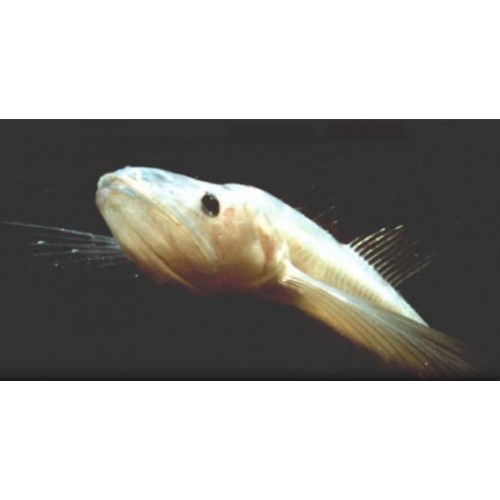
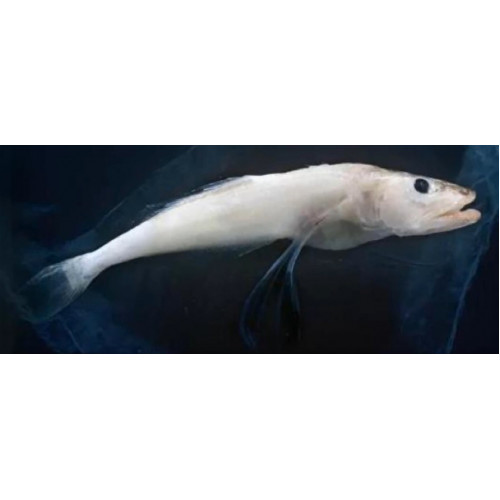
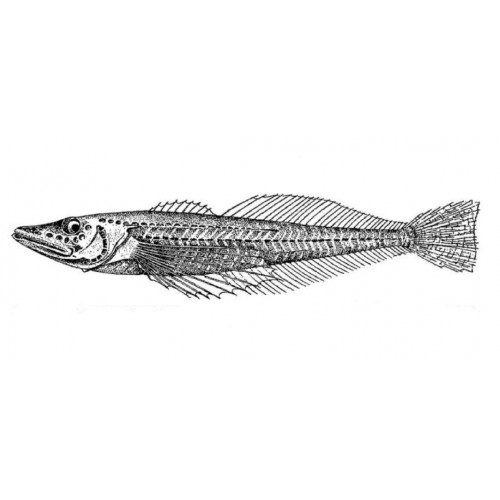
The body of the Big Baikal oilfish is slender, naked (devoid of scales), with very thin skin. The head is flattened with a large, oblique mouth and teeth. The teeth are small, hair-like (villiform), and present on both the inner and outer surfaces of the jaws. The eyes are large, and the head features well-developed cavities for the sensory organs of the lateral line system. The lateral line extends to the middle of the long second dorsal fin.
Features of Fish Fins
The caudal peduncle is very short. Pelvic fins are absent. The pectoral fins are very long. The anal fin is very long, symmetrical to the second dorsal fin. The rays of the anal fin extend to the marginal rays of the caudal fin.
Fish Coloration
The body of the Big Baikal oilfish is nearly transparent. The coloration is pale pink with a pearlescent sheen. Some specimens possess sparse star-shaped melanophores—tiny brown spots—on the back, the upper part of the head, and at the base of the caudal fin. The fins are transparent.
Distribution
Endemic to Lake Baikal.
Habitat
A freshwater potamodromous species. It leads a pelagic lifestyle, primarily inhabiting the open areas of the lake. Typically found at depths of up to 1600 meters.
Size
Females are larger than males, reaching up to 23 cm in length and 64 g in mass, while males do not exceed 15 cm in length and 21 g in mass. The head comprises nearly a quarter of the body length. It is an extremely fatty fish, resulting in a specific gravity lower than that of water; for instance, in large females, body fat can reach up to 40% of raw weight.
Behavior
In winter and early spring, it remains under the ice at depths of 25–400 meters, performing vertical migrations following its prey. In summer, the fish are found at depths from 300 to 1700 meters. Starting in autumn, the fish ascend to upper layers at night.
When it is time to release larvae, the female ascends to the surface, and due to the drastic pressure change, her abdominal cavity ruptures; the mother perishes, and the larvae are set free.
Food and Feeding Habits
Adults feed on macroplankton (the amphipod Macrohectopus branickii), larvae of their own species, and the little Baikal oilfish. Juveniles feed exclusively on Epischura baicalensis.
Reproduction
Sexual maturity is reached at 3 years of age. The fecundity of females aged 3–6 years averages between 1200 and 2675 oocytes. The species is characterized by viviparity (live-bearing). Mass larval release occurs in the second half of July or in August. The release period is protracted, and females with developed embryos can be found year-round. During the daytime, larvae remain at great depths, ascending to depths of around 10 meters at night. The maximum recorded age for females is 7 years, and for males, 4 years.
Fishing
The Big Baikal oilfish is a numerous but non-commercial species. It serves as a primary food source for the Baikal seal (Pusa sibirica), constituting up to 28% of its diet.
Relationship with Humans
Harmless. The oil (fat) of these fish is used in Eastern medicine and is highly valued.
| Classification | |
| Phylum | Chordata |
| Class | Actinopterygii |
| Squad | Perciformes |
| Family | Cottidae |
| Genus | Comephorus |
| Species | C. baikalensis |
| Features | |
| Conservation status | Least Concern |
| Habitat | Pelagic |
| Life span, years | 7 |
| Maximum body weight, kg | 0,064 |
| Maximum length, cm | 23 |
| Sailing speed, m/s | No information |
| Threat to people | Edible |
| Way of eating | Predator |
Big Baikal oilfish
Tags: big baikal oilfish