
Latin name
Trichogaster fasciata
Other Names
The banded gourami is also known as the striped gourami, rainbow gourami, Kholshe, Colisa, and giant gourami (though this name can cause confusion with Osphronemus goramy). Its scientific name, Trichogaster fasciata, was given by Bloch and Schneider in 1801. The genus name Trichogaster comes from the Greek words "thrix" (hair) and "gaster" (stomach). The species is known locally as Khalisha or Khosti in India and Bangladesh, Katara in Nepal, and Nga-Pyinthalet in Myanmar.
Identification
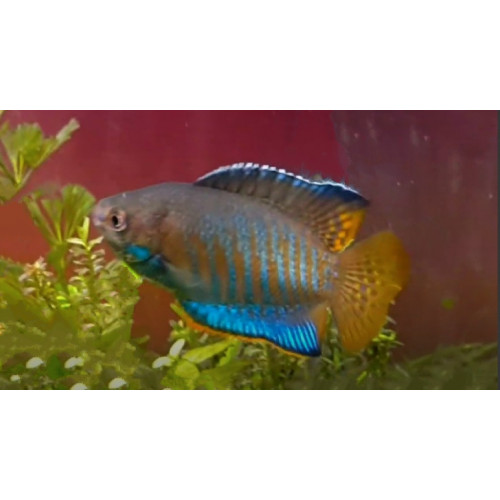
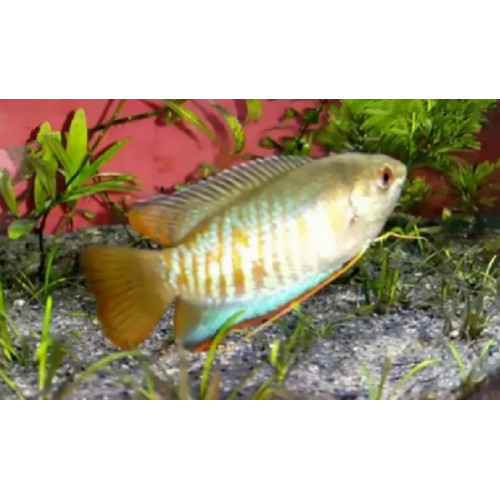
The banded gourami has an elongated, strongly compressed body with an egg-shaped profile. The mouth is small and slightly protrusible; the upper lip is papillose, especially in old males. The preorbital bone is serrated (saw-toothed) in young specimens. A distinguishing feature is the presence of 15–17 dorsal spines, 9–14 dorsal soft rays, 15–18 anal spines, and 14–19 anal soft rays. The vertebrae number 27. The species exhibits sexual dimorphism: males are more colourful and develop pointed dorsal and anal fins when mature, while females are smaller and less vividly coloured.
Features of Fish Fins
The banded gourami has a dorsal fin with 15–17 spines and 9–14 soft rays, and an anal fin with 15–18 spines and 14–19 soft rays. The dorsal and anal fins in males become more pointed at the posterior end as they mature, while in females they remain rounded. The pelvic fin is reduced to a long, filamentous ray. The caudal fin is rounded to truncate. The pectoral fins contain only soft rays.
Fish Colouring
The body is greenish with oblique orange or bluish bars descending downwards and backwards from the back to the anal fin. The vertical fins have alternating dark and pale spots or bars, and the anal fin often has a red or orange margin. The species has about 14 vertical bands above the lateral line. Males are much more colourful than females.
Distribution
The banded gourami is native to South and Southeast Asia, specifically Pakistan, India, Nepal, Bangladesh, and upper Myanmar. It has been widely transported around the world for the aquarium trade and as a food fish. Introduced populations exist in Taiwan, the USA, and Colombia. In India, it is found throughout the country, particularly in the eastern and north-eastern regions.
Habitat
This species is a freshwater, benthopelagic fish that prefers weedy environments. It occurs in large rivers, estuaries, ditches, ponds, lakes, and rice fields. It is an obligate air-breathing fish, possessing a labyrinthine organ that allows it to breathe atmospheric air, which is an adaptation to oxygen-depleted waters. The species prefers a pH range of 6.0–7.5, hardness of 4–15 dH, and a temperature of 22–28°C.
Size
The banded gourami can reach a maximum total length of 12.5 cm (about 5 inches). In its native range, males and females reach sexual maturity at about 10 cm and 6–8 cm, respectively. The species has a lifespan of approximately 4 years.
Behavior
The banded gourami is a benthopelagic species that spends most of its time near the bottom or in midwater, preferring weedy areas. It is an obligate air-breather, regularly rising to the surface to gulp air using its labyrinthine organ. The species is somewhat shy but quite hardy and adapts easily to life in a community aquarium. Males can be territorial during breeding season and will defend their bubble nests aggressively. It is known to feed on mosquito larvae, making it beneficial for controlling mosquito populations.
Food and Feeding Habits
The banded gourami is an omnivorous species with a generalist feeding habit. Its diet includes insect larvae, zooplankton, crustaceans, annelids, mollusks, and small fish. Juveniles feed mostly on zooplankton and insect larvae, while adults also consume small fish. In the aquarium, it readily accepts live, frozen, and flake foods. It has a long, coiled intestine, typical of omnivorous fish.
Reproduction
The banded gourami is a bubble nest builder. The species breeds once a year, with a single spawning season. Spawning occurs from April to August, with a peak in August. Males reach sexual maturity at about 10 cm, females at 6–8 cm, at approximately 1 year of age. The male builds a floating bubble nest from air bubbles and saliva, then courts the female underneath it. The female lays 500–600 non-adhesive eggs, which the male collects and deposits in the bubble nest. The male then defends the nest and guards the eggs and fry.
Fishing
The banded gourami is an economically important food fish in its native range, particularly in Bangladesh and eastern India. It is caught from the wild using traditional fishing methods and is sold fresh in local markets. Its demand often exceeds supply due to its taste and nutritional value. It is also exported to several countries for the aquarium trade.
Relationship with a Person
The banded gourami is not considered a threat to humans and is classified as harmless. It is valued both as a food fish and as an ornamental aquarium fish. In its native range, it is a popular food fish due to its taste and nutritional value. Its hardy nature and peaceful temperament make it a good choice for community aquariums, and it is easily bred in captivity. The species faces threats from habitat loss and pollution, with its natural populations declining due to anthropogenic stressors. The species is listed as Least Concern (LC) on the IUCN Red List, assessed on 21 January 2010.
Interesting facts
The story of the introduction of the labyrinth fish gourami to Europe is a classic example of how careful observation of nature can lead to unexpected solutions. The homeland of gourami is tropical Asia. There are several species of these fish: striped, spotted, blue, and pearl. The first attempts by Europeans to transport striped gourami ended in failure — all the fish died along the way, as no one knew how to transport them properly.
In 1871, a Frenchman, Paul Carbonnier, traveled to Asia in search of exotic fish. While observing gourami in their natural habitat, he noticed that they often rose to the water's surface and gulped air. Previously, gourami were transported in barrels completely filled with water, with a cloth placed on top to prevent splashing. Carbonnier realized that this was precisely what prevented the fish from surviving: they needed access to atmospheric air.
He filled the barrels with water only three-quarters full and left them open. The result exceeded all expectations — the fish successfully endured the long journey and arrived alive in Paris. Later, scientists discovered that gourami have a special labyrinth organ that allows them to breathe air in addition to using their gills. This discovery was the key to successfully transporting gourami to Europe.
| Classification | |
| Phylum | Chordata |
| Class | Actinopterygii |
| Squad | Anabantiformes |
| Family | Osphronemidae |
| Genus | Trichogaster |
| Species | Trichogaster fasciata |
| Features | |
| Conservation status | Least Concern |
| Habitat | Benthopelagic |
| Life span, years | 4 |
| Maximum body weight, kg | No information |
| Maximum length, cm | 12,5 |
| Sailing speed, m/s | No information |
| Threat to people | Edible |
| Way of eating | Omnivore |
Banded gourami
Tags: banded gourami