
Latin name
Toxotes jaculatrix
Identification
The genus name Toxotes is derived from Greek, meaning "archer" or "bow shooter." It refers to the constellation Sagittarius (the Archer). The species name jaculatrix translates to "thrower" (of darts or arrows), which perfectly describes this fish's hunting method.
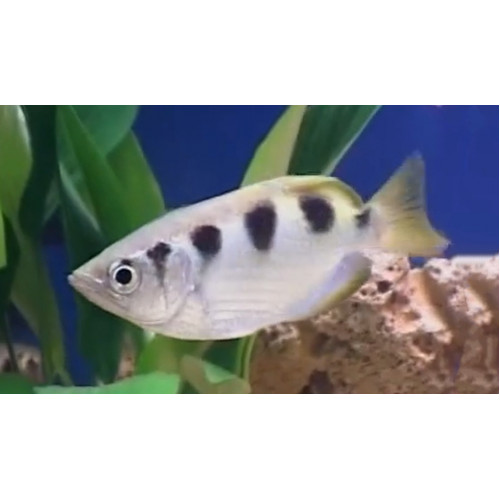
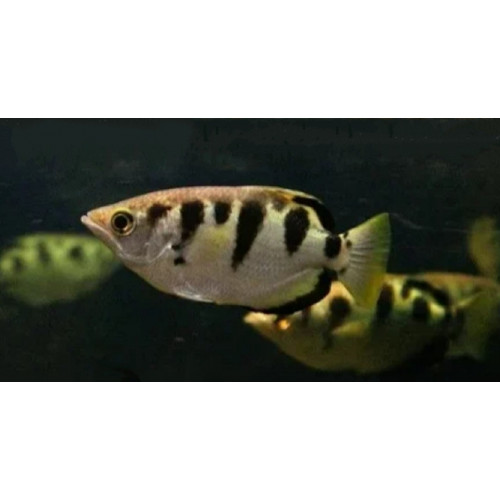
The banded archerfish has a fairly typical perch-like body shape, perfectly adapted for life near the surface.
Their body is deep, laterally compressed, flattened, and elongated. The head has a pointed snout. The mouth is quite large, with a slightly forward-protruding lower jaw.
The eyes are large and positioned so that the fish can see what is happening to the right, left, above, and behind without turning its head. However, it cannot see what is below. This makes sense: the aerial insects it feeds on do not crawl along the bottom, nor does it need to fear predators from below, as the banded archerfish stays in very shallow areas.
Unique hunting mechanism: The "spit" of water is undoubtedly the most famous feature of the banded archerfish, making it a star of nature documentaries. The fish creates a "water gun" by pressing its tongue against a groove in its palate, forming a narrow tube. Then, by sharply contracting its gill covers, it forces water through this channel. The result is a compact stream or series of droplets that fly at high speed.
These fish are natural-born snipers. They can hit a target (an insect on a branch) from a distance of up to 150 cm (59 inches). Large specimens can "shoot" at 2–3 meters (6.5–10 feet). Most amazingly, the fish can account for the refraction of light at the water-air interface. It visually calculates the correction so that the water jet reaches the target, which is not directly above it but at an angle. This ability requires complex three-dimensional calculations and indicates high intelligence. As soon as the knocked-down insect falls into the water, the fish rushes to it to beat competitors. According to research, the archerfish begins to move within 100 milliseconds of the shot and can grab prey less than 50 milliseconds after it touches the water.
Young fish learn to shoot by watching more experienced individuals. Juveniles often gather in schools and shoot collectively, increasing the chances of hitting the target. Besides "shooting," archerfish can also jump out of the water to grab prey from a low-hanging branch, but the "spit" is a less energy-intensive method.
Features of fish fins
The dorsal fin is shifted far back, closer to the tail; its base is shorter than the base of the long anal fin.
Dorsal fin: has 4 spiny and 11–13 soft rays.
Anal fin: has 3 spiny and 15–17 soft rays.
Fish coloring
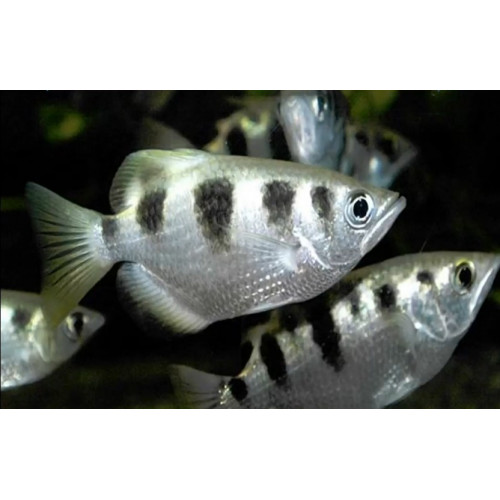
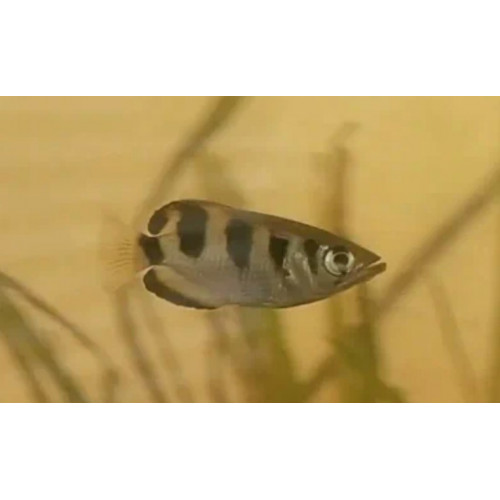
The main body color is silvery-white, which serves as excellent camouflage in the water column. The main distinguishing feature is 4–6 wide vertical bands of black or dark brown running along the upper part of the body. These bands are semicircular or wedge-shaped and may break up into individual spots. With age, the number of bands may decrease, and they become less noticeable. The back of the fish has an olive-green or brownish tint. The coloration of the fins varies from greenish on the dorsal fin to silvery on the anal fin.
Distribution
The banded archerfish is widely distributed in tropical and subtropical waters.
It is found in waters from India and Sri Lanka throughout Southeast Asia (Myanmar, Thailand, Vietnam, Malaysia, Indonesia, the Philippines) to northern Australia and Papua New Guinea, as well as on many islands of Oceania.
Habitat
It is an euryhaline species, meaning it can live in waters of varying salinity. Its primary habitats are the brackish waters of mangrove forests and river estuaries. However, these fish can also often be found in the fresh water of rivers and lakes, where they venture in search of food, and even in coastal marine waters near coral reefs. They prefer shaded areas with dense overhanging vegetation.
Size
The maximum length of this fish species in the wild is up to 30 cm (12 inches); in aquariums, up to 25 cm (10 inches). The usual length is about 20 cm (8 inches). It can be assumed that record-sized individuals about 30 cm long can reach a weight of 350–450 grams (12–16 oz). Lifespan under good aquarium conditions can reach 10 years; in the wild, their lifespan is unknown.
Behavior
They typically stay in small schools (3 to 5 individuals) that patrol the water's surface. Fish of the same size coexist peacefully, but larger individuals may show aggression toward smaller ones.
In experiments, scientists have found that archerfish can unmistakably recognize the face of a specific person among many others. Previously, it was believed that such a complex function was inherent only to higher primates.
Food and feeding habits
In the wild, the banded archerfish is an omnivorous hunter. Its predatory behavior manifests in a unique, highly specialized form. Their hunting strategy has no parallel among other freshwater fish.
Main diet: insects that the fish knocks off branches — flies, grasshoppers, spiders, and other arthropods.
Supplementary diet: readily eats small crustaceans (shrimp), worms, small fish, and may also feed on aquatic plants and fruits that fall into the water.
Reproduction
The reproduction of this species in the wild is poorly studied, and in captivity, it occurs extremely rarely.
It is believed that archerfish spawn during the rainy season, when water levels rise in rivers, and they gather in large schools for this purpose. Females lay between 20,000 and 150,000 eggs at a time. The eggs are lighter than water, float to the surface, and drift in the water column. Young fish become capable of reproduction when they reach a length of about 10 cm (4 inches).
Fishing
The banded archerfish is not a target of large-scale fishing, but local populations in Asia often consume it for food, as the meat is considered edible and tasty.
Relationship with a person
This species is completely safe for humans.
Despite its popularity, the banded archerfish is a challenging pet, suitable only for experienced aquarists.
| Classification | |
| Phylum | Chordata |
| Class | Actinopterygii |
| Squad | Carangiformes |
| Family | Toxotidae |
| Genus | Toxotes |
| Species | T. jaculatrix |
| Features | |
| Conservation status | Least Concern |
| Habitat | Pelagic-neritic |
| Life span, years | 10 |
| Maximum body weight, kg | 0,45 |
| Maximum length, cm | 30 |
| Sailing speed, m/s | No information |
| Threat to people | Edible |
| Way of eating | Predator |
Banded archerfish
Tags: banded archerfish