
Latin name
Perca schrenkii
Identification
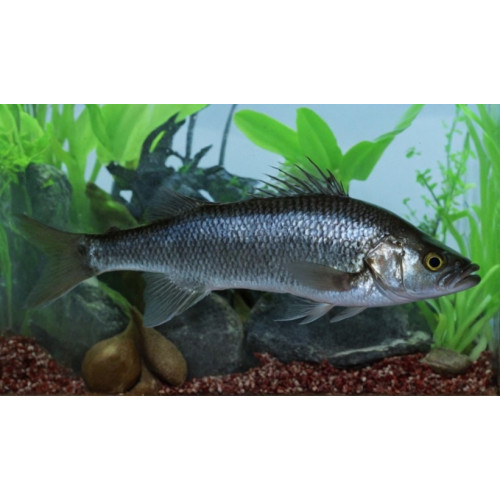
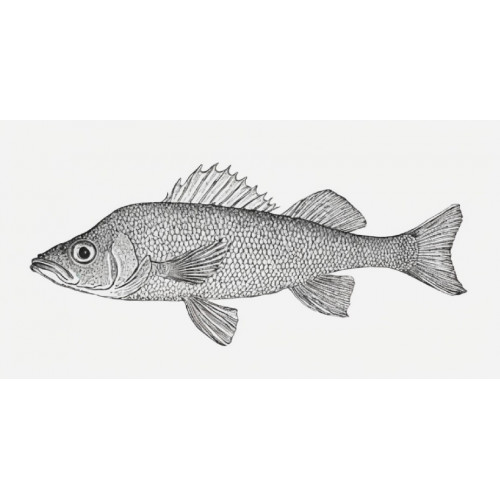
The closest relative is the European perch (Perca fluviatilis), from which the Balkhash perch diverged approximately 5–7 million years ago. It is distinguished by a more elongated body, the absence of a black spot on the dorsal fin and of transverse dark bands in adult fish, and a lower first dorsal fin. The upper jaw is very broad at the posterior end (its width reaches or even exceeds the diameter of the eye) and extends beyond the vertical midline of the eye. The lateral line has no more than 55 scales. It possesses 18 trunk and 20 caudal vertebrae. The number of gill rakers on the lower part of the first arch is 20–24, with the largest being equal in length to the gill filaments.
Features of Fish Fins
It has two dorsal fins: the first with 11–15 spiny rays, the second with 1–3 spiny and 10–14 soft rays. The anal fin has 1–3 spiny and 6–10 soft rays. The dorsal fins are well separated.
Fish Coloration
Coloration depends on habitat and varies from light gray to almost black. Fins are gray. Juveniles display 10–13 distinct transverse dark bands on the body, which almost completely disappear with age.
Distribution
Considered an endemic species of the Balkhash-Alakol lake system. It also inhabits the Ili River basin and other rivers of the Semirechye region. Historically, it populated various ecotopes within the basin except for mountainous water bodies. It was widespread in lakes Balkhash, Alakol, Sasykkol, Koshkarkol, and others, as well as in the lowland sections of their tributaries (the Ili, Karatal, Aksu, Lepsy, Ayaguz, Tokrau, Urjar, and other rivers).
Currently, the natural range of the Balkhash perch has severely contracted due to acclimatization efforts involving other predatory fish in the Lake Balkhash basin. It is now almost absent in Balkhash and the Ili River. Populations persist in the Alakol lakes, with smaller populations found in the left tributaries of the Kapshagay Reservoir and in the Aksu, Ayaguz, Karatal, and Baskan rivers. It has disappeared from the Kurtinskoye and Saztalgarinskoye reservoirs but has recently been observed again in Lake Balkhash.
Habitat
A freshwater fish species preferring a temperate climate.
Size
It reaches a weight of up to 1.5 kg at a length of 50 cm. The maximum recorded age is 18 years (fast-growing pelagic form). The slow-growing, benthivorous form does not exceed 250 grams in weight.
Behavior
Two forms exist: a fast-growing, more piscivorous pelagic form and a slow-growing, benthivorous littoral form.
Food and Feeding Habits
In its early years, the perch feeds on invertebrates (larvae of Chironomidae, Ephemeroptera, Trichoptera, as well as mysids and amphipods). By the fourth or fifth year (and earlier in some water bodies), it shifts to piscivory, primarily consuming its own young and, less frequently, fry of other fish (common carp, crucian carp, marinka, loaches). Fish constitute a larger portion of the diet for the pelagic form compared to the littoral form. Feeding intensity decreases sharply during the spawning period.
Practicing intraspecific cannibalism enables it to exist in enclosed water bodies where other suitable food is absent or unavailable.
Reproduction
The pelagic form exhibits faster growth and later maturation (by one year) compared to the littoral form. In Lake Balkhash, it typically reaches sexual maturity at 2–3 years of age with a body length of 7–10 cm; in the Alakol lakes, maturation occurs in the third to fifth year. Males mature one year earlier than females. The sex ratio in populations is highly variable, ranging from 1:1 to a sharp predominance of females (up to 24:1).
Spawning begins in early spring, shortly after ice break-up, and continues from late March to late May. Water temperature during spawning is typically 8–10°C. It reproduces in both fresh and brackish water. Similar to the European perch, eggs are deposited as a sticky ribbon on submerged coastal vegetation and branches at depths from a few centimeters to 2–3 meters. Spawning grounds sometimes feature very dense aggregations—up to 20 individuals per square meter. In cases of spawning substrate shortage, eggs may be laid directly on the substrate. Fecundity ranges from 1.3 thousand to 245 thousand eggs.
Fishing
It is a commercial species in Lake Balkhash.
Listed in the Red Book of Kazakhstan; harvest is prohibited.
Relationship with Humans
Harmless. Balkhash perch is processed into salted, dried, and frozen products. Its meat is similar in taste to that of pikeperch (Sander lucioperca).
| Classification | |
| Phylum | Chordata |
| Class | Actinopterygii |
| Squad | Perciformes |
| Family | Percidae |
| Genus | Perca |
| Species | P. schrenkii |
| Features | |
| Conservation status | Least Concern |
| Habitat | Pelagic |
| Life span, years | 18 |
| Maximum body weight, kg | 1,5 |
| Maximum length, cm | 50 |
| Sailing speed, m/s | No information |
| Threat to people | Edible |
| Way of eating | Predator |
Balkhash perch
Tags: balkhash perch