
Latin name
Leuciscus aspius
Identification
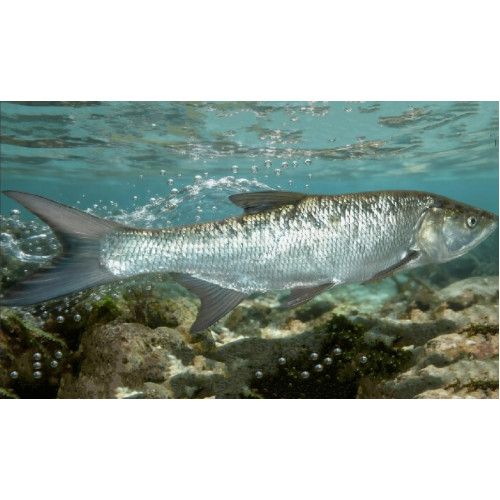
The asp is a true "torpedo-shaped" predator, whose appearance reveals it as a swift hunter.
The body of the asp is elongated, drawn out, slightly compressed laterally, with a wedge-shaped head. This shape provides excellent hydrodynamics and allows it to develop high speed when lunging for prey. A distinctive feature is its powerful, upward-directed mouth with a protruding lower jaw. The upper jaw extends far beyond the front edge of the eye. At the tip of the lower jaw, there is a small tubercle that fits into a notch on the upper jaw. There are no teeth on the jaws; food is ground by powerful pharyngeal teeth. The scales are small and tightly attached. There are 64–76 scales along the lateral line.
Features of fish fins
Dorsal fin: has 3 rigid and 7–9 soft rays; located behind the pelvic fins.
Anal fin: long, with 3 rigid and 12–15 soft rays; the first rays are noticeably longer than the subsequent ones.
Caudal fin: large, deeply forked, powerful.
Fish coloring
The back is dark, with a greenish or bluish-gray tint; the sides and belly are silvery, gleaming brightly in the sun. The pectoral, pelvic, and anal fins in adults may have a reddish tint, while the dorsal and caudal fins are gray or bluish.
Distribution
It is found in the rivers of the Baltic (southern tributaries, southern Sweden and Finland), Black, Azov, and Caspian Sea basins. To the west, its natural range extends as far as the Elbe and Weser rivers. In recent decades, the asp has been actively expanding its range westward: after the construction of the Rhine–Main–Danube Canal, it penetrated the Rhine and its tributaries, and then the Loire and other rivers of France.
Habitat
A typical inhabitant of large lowland rivers and large lakes. It prefers open sections of rivers with moderate to fast currents, stays at depth, and likes to position itself near bridge supports, below dams, close to the mouths of tributaries, and in overgrown backwaters.
Size
Maximum length of this fish species is up to 120 cm (47 inches), averaging 50–80 cm (20–31 inches). Typical weight is 0.7–2 kg (1.5–4.4 lbs). Maximum weight is up to 12 kg (26 lbs), with an officially recorded 9 kg (20 lbs). It grows fairly quickly for a cyprinid fish. By one year, it reaches 10–15 cm (4–6 inches); by 3–4 years, 30–40 cm (12–16 inches).
Maximum recorded age is 11 years (although some sources indicate up to 15 years).
Interestingly, in different parts of its range, the asp reaches different sizes. In Western Europe, specimens up to 80–90 cm (31–35 inches) and weighing up to 5 kg (11 lbs) are more often caught. Meanwhile, in the rivers of Russia and the reservoirs of North Africa (where it has been introduced), it can grow up to 120 cm (47 inches) and weigh over 12 kg (26 lbs).
Behavior
It leads a solitary lifestyle or hunts in small groups. It is known for its spectacular attacks on surface fish — it strikes forcefully with its tail, stunning the prey, then seizes it. It often hunts in the upper water layers; its presence is betrayed by characteristic "boils" — splashes and spray on the surface.
Food and feeding habits
It is the only true predator among European cyprinids. Its diet consists almost entirely of fish.
Its primary prey is the bleak. It also hunts juvenile bream, roach, dace, smelt, and other species. Large individuals may occasionally eat water birds (e.g., chicks) as well as large insects. Fry initially feed on zooplankton and then switch to a fish diet.
The asp pursues its prey, often hunting in surface layers. When lunging, it is capable of leaping out of the water. Small fish are swallowed whole; larger prey is torn apart.
Reproduction
An anadromous or semi-anadromous fish: it undertakes spawning migrations upstream in rivers.
Spawning occurs in early spring (April–June), when the water warms to +6°C... +10°C (43–50°F). The fish move upstream to riffles with rocky or pebbly bottoms and fast currents. The female spawns 80,000 to 200,000 eggs. The eggs are adhesive, attaching to stones and gravel. The hatched larvae drift downstream to calmer waters. Sexual maturity is reached at 4–5 years of age, at a length of about 30–40 cm (12–16 inches).
It can hybridize with the ide (or river ore), producing hybrid offspring.
Fishing
A valuable target for sport and recreational fishing throughout Europe.
The asp is considered one of the strongest and most spectacular fighters among freshwater fish. When being reeled in, it puts up powerful resistance, makes sharp runs, and leaps beautifully out of the water. It is caught using fly fishing (the classic method, especially effective during mass insect hatches), spinning, or live bait.
It has limited commercial value. In some regions (e.g., the Curonian Lagoon), commercial fishing is conducted, although catch volumes are small.
Relationship with a person
Globally, this species has a conservation status of Least Concern. However, in some regions, its populations are declining.
Its gastronomic appeal is not high. The meat is rather bony, and large specimens may have a specific odor due to the slime on their bodies.
| Classification | |
| Phylum | Chordata |
| Class | Actinopterygii |
| Squad | Cypriniformes |
| Family | Leuciscidae |
| Genus | Leuciscus |
| Species | L. aspius |
| Features | |
| Conservation status | Least Concern |
| Habitat | Pelagic |
| Life span, years | 15 |
| Maximum body weight, kg | 12 |
| Maximum length, cm | 120 |
| Sailing speed, m/s | No information |
| Threat to people | Edible |
| Way of eating | Predator |
Asp
Tags: asp