
Latin name
Austrolebias bellottii
Other Names
The Argentine pearlfish is also known by the synonym Cynolebias bellottii. Its scientific name, Austrolebias bellottii, was given by Steindachner in 1881. The species is named after Cristoforo Bellotti (1823–1919), an Italian ichthyologist and palaeontologist. In Spanish, it is known as pavito.
Identification
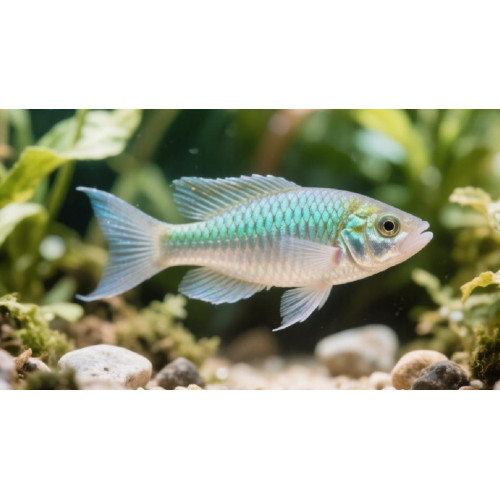
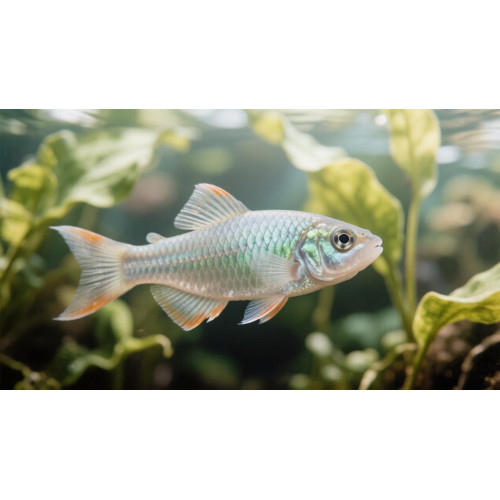
The Argentine pearlfish has a laterally compressed, fusiform (spindle-shaped) body with a rounded profile. Males are more brightly coloured than females, with iridescent blue-green spots and markings on a brownish-grey background. Females are smaller and less colourful, with a more subdued mottled pattern. The species reaches a maximum length of 7 cm TL (total length) for males.
Features of Fish Fins
The Argentine pearlfish has no spines in its fins. The dorsal fin has 14–18 soft rays, and the anal fin has 19–23 soft rays. In males, the anal fin is more elongated and pointed than in females. The pectoral and pelvic fins are rounded.
Fish Colouring
Males are brownish-grey with a metallic blue-green iridescence on the flanks, covered with numerous small pearly spots. Females are olive-brown with darker mottling and lack the bright iridescent spots. During the breeding season, males become particularly vibrant.
Distribution
The Argentine pearlfish is native to South America, specifically the lower Paraná and Uruguay River basins in Argentina and Uruguay. It has been introduced to California, USA, as a mosquito control agent, but these populations have failed to establish.
Habitat
This species is a freshwater, benthopelagic fish that inhabits temporary pools, swamps, and flooded grasslands of subtropical South America. It prefers soft, acidic water with a pH of 6.5–7.0 and a temperature range of 18–22°C. The species is non-migratory.
Size
The Argentine pearlfish can reach a maximum total length of 7 cm for males. Females are slightly smaller, reaching around 5 cm. The maximum reported age is 1 year.
Behavior
The Argentine pearlfish is a seasonal annual fish. It lives in temporary waters that dry up during the dry season, and adults die as the water disappears. The species is benthopelagic, spending most of its time near the bottom. It is easy to maintain in the aquarium.
Food and Feeding Habits
The Argentine pearlfish is a carnivorous predator that feeds on worms, crustaceans, and insects. In the aquarium, it accepts live and frozen foods such as bloodworms, daphnia, and brine shrimp.
Reproduction
The Argentine pearlfish is a bottom spawner. Females lay their eggs in the substrate of temporary pools, and the eggs survive in the mud during the dry season for up to 4 months of incubation. When the rains return, the eggs hatch, and the fry grow rapidly. This species reaches maturity in a single season and completes its entire life cycle within one year.
Fishing
The Argentine pearlfish is of minor commercial importance in its native range as a food fish, but it is also part of the subsistence fishery. Its primary value to humans is in the aquarium trade, where it is a popular ornamental species.
Relationship with a Person
The Argentine pearlfish is not considered a threat to humans and is classified as harmless. It has been used in California as a potential mosquito control agent, though these introductions failed. In the aquarium hobby, it is a popular species known for its hardiness and bright colouration, though its short lifespan of just one year is a consideration for aquarists. The species is listed as Near Threatened (NT) on the IUCN Red List, assessed on 19 February 2021.
Interesting facts
The eggs of the Argentine pearlfish can be sent in a postal envelope, and fry can be hatched from them. This amazing ability is directly related to the conditions in which the fish lives in the wild.
The fish inhabits seasonal water bodies — temporary puddles and ponds. These water bodies dry up completely during the dry season. To ensure the survival of the species, females lay their eggs in the substrate at the bottom of the water body. These eggs can remain in a state of diapause (suspended development) in dry mud for several months, waiting out the drought.
Aquarists use this feature to send eggs by mail. The eggs are mixed with moist peat or coconut fiber, packaged in an envelope, and they easily survive transportation. Upon receiving the package, the aquarist adds water to the peat with eggs. Because, in nature, the eggs wait for the start of the rainy season, under favorable conditions they quickly "awaken" — larvae can hatch within a few hours.
Not all eggs hatch at once: this is a natural insurance mechanism. If all eggs hatched after the first rain, and then a new drought occurred, the entire brood would die. Therefore, some of the eggs may remain "dormant" until the next "flooding.
| Classification | |
| Phylum | Chordata |
| Class | Actinopterygii |
| Squad | Cyprinodontiformes |
| Family | Rivulidae |
| Genus | Austrolebias |
| Species | Austrolebias bellottii |
| Features | |
| Conservation status | Near Threatened |
| Habitat | Benthopelagic |
| Life span, years | 1 |
| Maximum body weight, kg | No information |
| Maximum length, cm | 7 |
| Sailing speed, m/s | No information |
| Threat to people | Edible |
| Way of eating | Predator |
Argentine pearlfish
Tags: argentine pearlfish