
Latin name
Schizothorax intermedius
Other Names
The Aral Basin snowtrout is known by several alternative names, including common marinka and sattar snowtrout. Its scientific name, Schizothorax intermedius, was given by McClelland and Griffith in 1842. The species is also known by the synonym Schizothorax schumacheri Fowler & Steinitz, 1956. In Persian, it is called Khajoo; in Russian, it is known as common marinka. In Kazakhstan, it is called Kadimgi karabalyk.
Identification
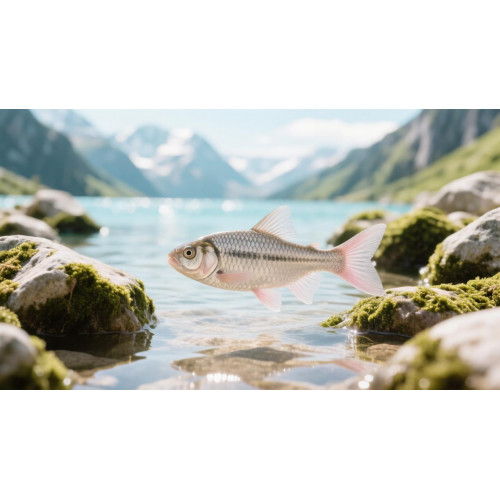
The Aral Basin snowtrout has a fusiform (spindle-shaped) body. The head is flat on the upper surface, with a horseshoe-shaped mouth that is inferior (positioned on the underside of the head). The snout overhangs the upper jaw, which projects beyond the lower jaw; the lower jaw has a thin, smooth, deciduous horny covering. The mouth cleft is nearly horizontal, and the gape is one and a half times greater in extent than the cleft. The lower labial fold is interrupted in the middle. Four barbels are present, about as long as the eye. Pharyngeal teeth are pointed and somewhat crooked at their summits, with a formula of 5,3,2 — 2,3,5. Gill rakers are numerous, ranging from 10 to 19, and the lateral line contains 85 to 122 scales.
Features of Fish Fins
The dorsal fin is short and contains 3 or 4 spines (unbranched rays) and 5 to 9 soft rays, typically 8. The last undivided ray is osseous (bony), strong, and coarsely serrated posteriorly; its length is more than half the length of the head. The dorsal fin originates slightly in advance of the pelvic fins. The anal fin has 1 to 3 spines and 4 to 7 soft rays, typically 5. The pectoral fins have 17 to 19 rays, and the pelvic fins have 8 to 11 rays. The caudal fin is deeply forked. All fins are generally short and rounded.
Fish Colouring
The colouration of the Aral Basin snowtrout is predominantly silvery. The body is usually silvery without spots, but some specimens may have numerous minute black spots on the upper half of the body. The spots, when present, are most distinct in the upper half of the body. The upper surface of the head is flat.
Distribution
The Aral Basin snowtrout is widely distributed in West and Central Asia, including Iran, Afghanistan, Uzbekistan, Kazakhstan, and Kyrgyzstan. It is found in the Syr Darya and Amu Darya river systems and also in the Talas River endorheic basin. Within Afghanistan, it is recorded from the Kabul River and Tarnuck River. In Iran, it inhabits the Hari and Sistan basins.
Habitat
This species inhabits a wide range of freshwater habitats, including rivers and occasionally lakes, but is usually found in flowing waters. It prefers well-oxygenated, fast-flowing streams and rivers. It is a freshwater species that is benthic (bottom-dwelling).
Size
The Aral Basin snowtrout can reach a maximum total length of up to 56 cm (22 inches) and a weight of up to 1.3 kg (2.9 lb). Historical records indicate specimens of at least 11 inches (about 28 cm) in length.
Behavior
The Aral Basin snowtrout is a freshwater fish that is well-adapted to flowing waters. It is a schooling species and is known to migrate seasonally within river systems. Studies have shown that the species is sensitive to human impacts, with decreasing maximal age and body length observed in populations from impacted areas of the Syr Darya River. It can serve as a bioenvironmental sentinel organism for human impact assessment.
Food and Feeding Habits
The Aral Basin snowtrout is an omnivorous species that feeds on a variety of aquatic organisms, including insects, algae, and detritus. Its feeding habits make it an important component of the local food web.
Reproduction
The species reaches sexual maturity at a certain size and age, typically spawning in spring or early summer. Eggs are deposited in gravel beds in flowing water, where they develop and hatch.
Fishing
The Aral Basin snowtrout is a commercially important species. It is caught using various methods, including nets and traps, and is marketed fresh, dried, or salted. The species is an important food source for local communities and is also used as bait.
Relationship with a Person
The danger of the Aral Basin snowtrout is associated with ichthyotoxins — substances that are not destroyed by ordinary heat treatment. In this species, the peritoneum, eggs, and milt are considered poisonous, and toxicity may vary depending on the species and the body of water. The meat itself is generally edible, but when cleaning the fish, it is extremely important to carefully remove all internal organs without damaging them, and to prevent poisonous mucus or eggs from coming into contact with the fillet.
The Aral Basin snowtrout is primarily important to humans as a fishery resource. However, the species is also valuable as a sentinel organism for monitoring human impacts on freshwater ecosystems. The species is listed as Least Concern (LC) on the IUCN Red List, with its status assessed as stable and of low priority for conservation action. Threats include habitat destruction, fishing, and pollution.
| Classification | |
| Phylum | Chordata |
| Class | Actinopterygii |
| Squad | Cypriniformes |
| Family | Cyprinidae |
| Genus | Schizothorax |
| Species | S. intermedius |
| Features | |
| Conservation status | Least Concern |
| Habitat | Bottom |
| Life span, years | No information |
| Maximum body weight, kg | 1,3 |
| Maximum length, cm | 56 |
| Sailing speed, m/s | No information |
| Threat to people | Edible |
| Way of eating | Omnivore |
Aral Basin snowtrout
Tags: aral basin snowtrout