
Latin name
Salmo oxianus
Other name
Bamean trout, salmo trutta aralensis, salmo trutta oxianus.
Identification
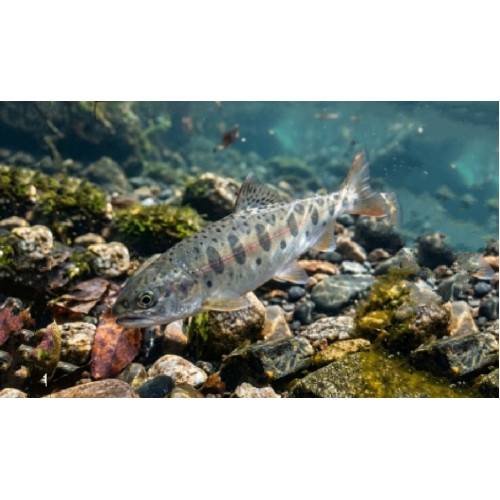
The Amu-Darya trout, in its external appearance, is typical of salmonid fish but has its own unique features associated with isolation in the mountain rivers of Central Asia.
It has an elongated, cylindrical (torpedo-shaped) body, perfectly adapted for life in fast mountain streams. The head is large, with a wide mouth, revealing it as a predator.
The appearance of this trout is highly dependent on habitat conditions. In large, deep rivers, it is larger and lighter; in small mountain tributaries, it is darker and smaller.
Scientists still debate whether this is a separate species (Salmo oxianus) or merely an isolated population of brown trout (Salmo trutta oxianus). According to recent data, they are increasingly leaning toward the status of a separate species.
Features of fish fins
The dorsal fin is located in the middle part of the back. The caudal fin is slightly forked or truncated and powerful, providing sharp bursts of speed. An adipose fin — a small fleshy protrusion on the back in front of the tail — is a characteristic feature of all salmonid fish.
Fish coloring
The coloration varies from silvery to golden-brownish, depending on water clarity and bottom type. A characteristic feature is the many small dark spots (speckles) scattered across the entire body and dorsal fin. Because of this, it is often called "speckled trout." The belly is usually light, yellowish or white. The dorsal fin has a dark spotted coloration.
Distribution
It is a Central Asian endemic. Its main range is concentrated in the upper Amu Darya basin — the largest river in Central Asia.
It is surprising that the ancestor of the Atlantic salmon was able to adapt to life in the arid zone of Central Asia.
Habitat
This is primarily a demersal (benthic), cold-water species that inhabits areas with fast currents, rocky bottoms, and clean, oxygen-rich water. It stays near the bottom, often hiding behind boulders and in riffles.
Size
Average weight of this fish species is 2 kg (4.4 lbs). Trophy weight is 7–8 kg (15–17.6 lbs), rarely encountered. Historical record weight is up to 27 kg (60 lbs), recorded in the USSR. Length up to 100–120 cm (39–47 inches), corresponding to weight. It grows slowly and reaches sexual maturity late.
There is no precise data on maximum age, but considering its close relation to the brown trout (Salmo trutta), which lives 10–15 years or more (individuals up to 18–20 years are known), similar numbers can be assumed.
Behavior
It leads a solitary lifestyle, hunting from its own territory. Unlike many salmonids, this fish does not undertake long migrations to the sea (landlocked form), although historically it may have also inhabited the brackish waters of the Aral Sea.
It is most active in spring and early summer, when it actively builds up fat after winter, as well as in August. During the hot summer months, it becomes sluggish. It winters in deep pools.
Food and feeding habits
It is an active predator. It feeds on benthic invertebrates: larvae of caddisflies, mayflies, stoneflies, as well as amphipods. This is the food base of mountain rivers. Larger individuals switch to a fish diet, hunting char (another common inhabitant of these rivers) and the young of other species. They are known for their passion for insects falling into the water (beetles, grasshoppers), which makes them a coveted catch for fly fishermen.
Reproduction
Spawning occurs in autumn (late October to December). For spawning, the fish moves upstream to riffles with pebbly bottoms and fast currents. It spawns in cold water at temperatures of about 4–8°C (39–46°F). The female lays eggs in a depression dug with her tail in the gravel. The eggs are large and orange. After fertilization, the male and female bury the nest. The fry hatch in spring and live in shallow waters for a long time.
Fishing
A dream for sport fishermen.
It has no commercial value due to its scarcity. Nevertheless, it is a coveted trophy for local fishermen and tourists. Fly fishing is considered the classic method of capture, as the fish readily takes artificial flies that mimic fallen insects. Spinning rods and float rods are also used. Fishermen say that the Amu-Darya trout fights to the very end, providing a wealth of emotion when reeling it in.
Relationship with a person
Although there is no official IUCN status for this subspecies, the population is under threat. The main risks are poaching, dam construction (disrupting spawning routes), water diversion for irrigation (drying up rivers), and pollution.
The meat of this fish is highly valued by gourmets. Like most salmonids, the fillet of this fish is almost completely free of small bones, making it convenient for cooking and eating.
| Classification | |
| Phylum | Chordata |
| Class | Actinopterygii |
| Squad | Salmoniformes |
| Family | Salmonidae |
| Genus | Salmo |
| Species | S. oxianus |
| Features | |
| Conservation status | Not Evaluated |
| Habitat | Bottom |
| Life span, years | 20 |
| Maximum body weight, kg | 27 |
| Maximum length, cm | 120 |
| Sailing speed, m/s | No information |
| Threat to people | Edible |
| Way of eating | Predator |
Amu-Darya trout
Tags: amu darya trout