
Latin name
Monocirrhus polyacanthus
Other name
South American leaffish
Identification
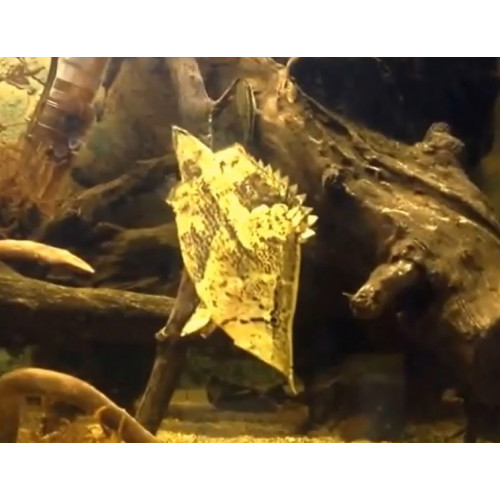
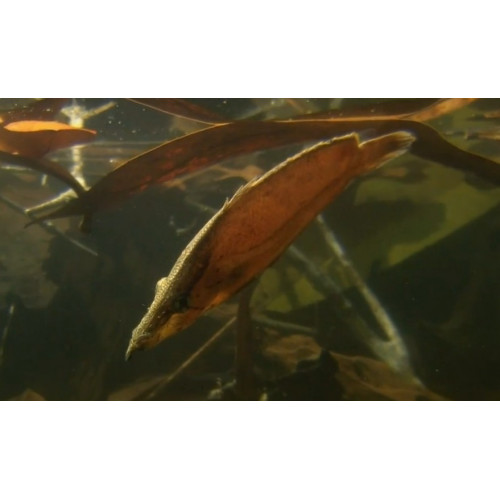
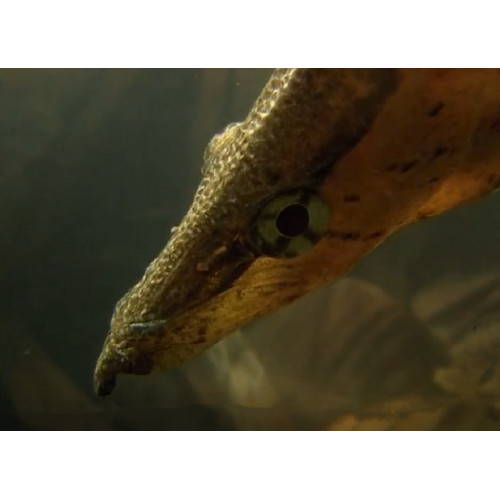
The Amazon leaffish resembles dead yellow-brown leaves in color and body shape. On the tip of the lower jaw there is a forward-directed, immovable barbel. The oral cavity makes up 60% of the head length. They have no lateral line.
Features of fish finsThey have five fins: two pectoral fins, one dorsal fin, one anal fin, and one caudal fin. The dorsal fin is long, with pointed rays. The caudal fin is not forked and has the shape of a narrow triangle.
Fish coloring
The Amazon leaffish is olive with dark transverse stripes that resemble leaf veins, but it can change its color to some extent. The soft parts of the dorsal, anal, and caudal fins are transparent. When frightened, the fish compresses all its fins, freezes, tips over on its side, and slowly descends to the bottom in a spiral, playing dead like a fallen leaf.
Distribution
They are distributed throughout the Amazon basin in Bolivia, Brazil, Colombia, Peru, and Venezuela.
Habitat
This is generally a low-density species that inhabits slow-moving or essentially still waters in areas with plant debris. They settle along the banks of rivers, lakes, and streams.
Size
The Amazon leaffish reaches a maximum standard length of 8 cm (3.1 inches), with a total length of 10 cm (3.9 inches).
Behavior
Prey fish are swallowed whole and are often quite large compared to the size of the leaffish. The length of the prey is typically about 1/3 the length of the Amazon leaffish, but can reach approximately 2/3 of its length. Camouflage allows the fish both to avoid the attention of large predators and to ambush small prey.
Food and feeding habits
A highly predatory species, feeding on small invertebrates (aquatic insects such as mayfly nymphs, and crustaceans such as shrimp) and fish (especially characids and lebiasinids). Larger individuals feed mainly on fish. They swim very slowly with their head pointed downward, resembling a dead leaf drifting with the current, in order to approach their prey. When close, they extend their mouth, forming a tube. Prey is quickly sucked in, usually headfirst. Prey in their stomach is often folded, allowing the Amazon leaffish to fit relatively large items inside.
Reproduction
Before breeding, the pair swims together. The female lays up to 300 eggs on the underside of a stone or plant leaf, which are then fertilized by the male. The male cares for the eggs, which hatch within 3–4 days. They are predators from the very beginning of their lives; in captivity, they are first fed tiny animals such as brine shrimp and water fleas.
Fishing
This fish species is not a target of fishing in the traditional sense, as it inhabits freshwater bodies rather than marine or ocean waters. It is said that before catching such a fish with a net, you have to scoop up many water-soaked dead leaves from the water and examine them very carefully. It is not an edible fish.
Relationship with a person
The Amazon leaffish is sometimes kept in aquariums, but they require acidic water, low lighting, and live prey. On average, the lifespan of these fish in an aquarium is 8 years.
| Classification | |
| Phylum | Chordata |
| Class | Actinopterygii |
| Squad | Cichliformes |
| Family | Polycentridae |
| Genus | Monocirrhus |
| Species | M. polyacanthus |
| Features | |
| Conservation status | Least Concern |
| Habitat | Coastal |
| Life span, years | 8 |
| Maximum body weight, kg | No information |
| Maximum length, cm | 10 |
| Sailing speed, m/s | No information |
| Threat to people | Not edible |
| Way of eating | Predator |
Amazon leaffish
Tags: amazon leaffish