
Latin name
Plotosus lineatus
Identification
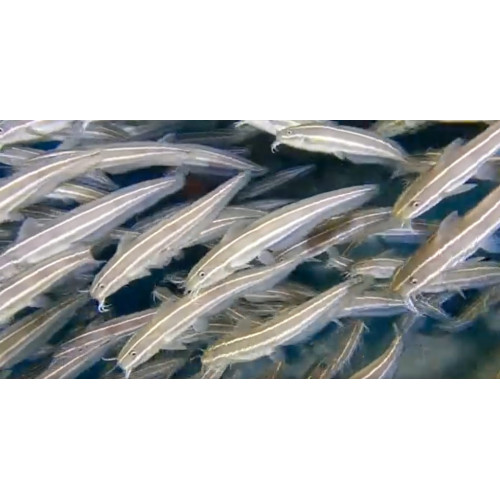
The striped eel catfish has such a unique appearance that it is difficult to mistake it for any other fish.
The body of this fish is elongated, cylindrical, tapering into a long, laterally compressed tail that resembles an eel. Scales are completely absent. The entire rear part of the body, including the caudal fin, forms a single continuous fin margin. Due to this fusion of the second dorsal, caudal, and anal fins, it received its English name "eel catfish."
Barbels and spines – the main danger! As with all catfish, the mouth of the striped eel catfish is surrounded by four pairs of long barbels. On the back is the first dorsal fin with one powerful serrated spine. A similar venomous spine is also present on each of the pectoral fins. These spines are the fish's main weapon and means of defense.
These fish have special electroreceptors (ampullae of Lorenzini) with very long canals, which help them find prey in darkness and murky water.
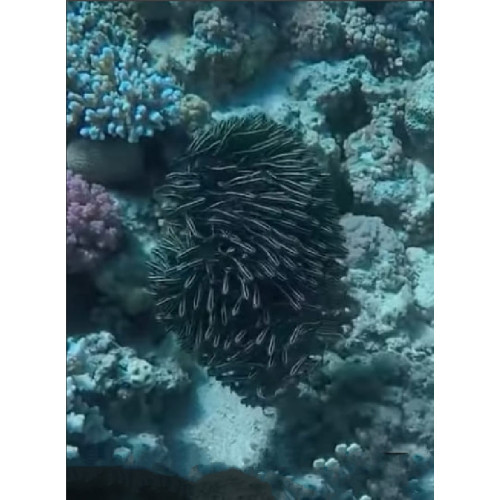
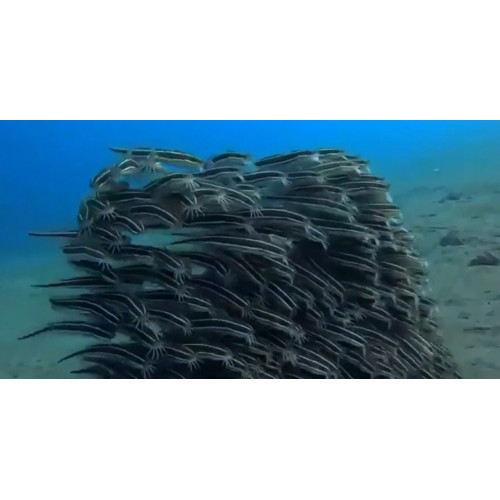
The dense spherical schools of juveniles are often mistaken for sharks or rays. This formation allows them to appear larger and deter predators, despite their tiny size.
Features of fish fins
The most striking feature of this fish is that its second dorsal, caudal, and anal fins are fused into a single long ribbon that frames the rear part of the body. Because of this, the fish looks like an eel. The number of soft rays in this unified structure is very large and varies.
Fused second dorsal fin: has 69 to 115 soft rays.
Fused anal fin: has 58 to 82 soft rays.
In addition to this long "skirt," the fish has other fins, two of which carry serious danger.
First dorsal fin: a short fin in the front part of the back. It consists of just one thick, serrated spiny ray and 4 soft rays. This spine is venomous.
Pectoral fins: located on the sides of the body, each has one venomous serrated spine and 9 to 13 soft rays.
Pelvic fins: located on the belly, closer to the head. They have no spiny rays, only soft rays — 10 to 13.
Fish coloring
The coloration of the striped eel catfish is its main calling card.
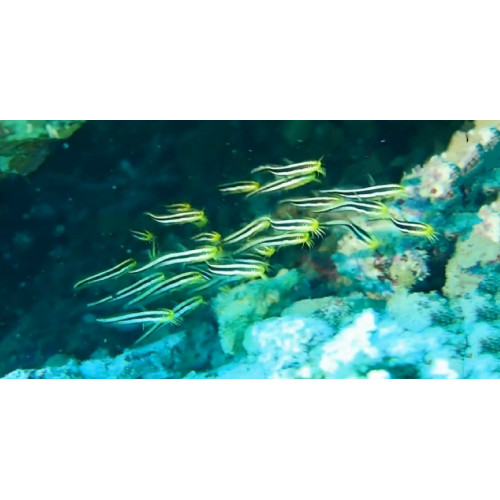
Juvenile coloration: juveniles have bright, contrasting coloration — a dark brown or black body with two sharp white longitudinal stripes along the sides. This bright coloration serves as a warning to predators of the fish's venomous nature.
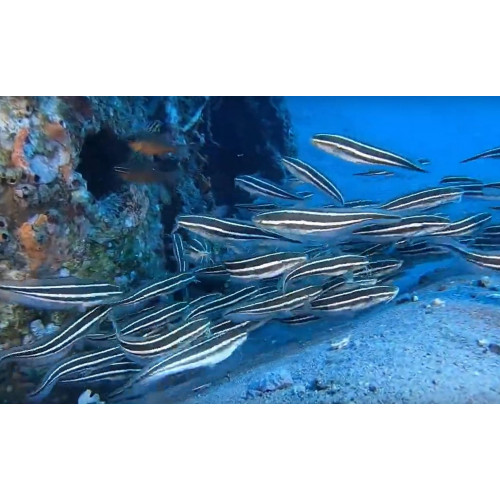
Adult coloration: as the fish matures, the coloration fades. The stripes become less noticeable, and the body takes on a uniform brown or dusky color. The belly remains white or cream-colored.
Distribution
This species is widely distributed in the Indo-Pacific region — from East Africa and the Red Sea to Japan, Australia, and Samoa. It is capable of living in a wide variety of conditions: in coral reefs, mangrove forests, river estuaries, and can even enter fresh waters.
Since 2002, P. lineatus has been recorded in the Mediterranean Sea, where it likely arrived via the Suez Canal. Since then, it has spread rapidly along the coast and is now considered an invasive species, included in the European Union's list of dangerous alien species. Its appearance threatens local ecosystems, as it is a serious competitor to native species.
Habitat
The habitat of these fish changes as they mature. Juveniles form dense schools and prefer shallow areas, often over sandy bottoms. Adults lead a more solitary lifestyle, gathering in groups of up to 20 individuals. During the day, they usually hide under rock ledges and coral overhangs, emerging to hunt at dusk and at night.
Thus, the striped eel catfish is a flexible species, successfully colonizing both natural reef ecosystems and new regions where it has been introduced by human activity.
Size
The striped eel catfish is a medium-sized fish, and its parameters are quite well studied. Adults typically reach a length of about 25 cm (10 inches), and the largest recorded specimens grow up to 35.2 cm (13.9 inches). Typically, in the waters of the Indo-Pacific region, individuals up to 20–30 cm (8–12 inches) are more common.
The weight of this fish is directly related to its length and can vary greatly. For example, juveniles raised in cages can weigh from 5 to 32 grams (0.18–1.1 oz) at a length of 9–18 cm (3.5–7 inches). Adults, according to studies, reach weights of up to 45 grams (1.6 oz) at a length of about 17 cm (6.7 inches). There is also data on larger individuals: in some populations off Taiwan, specimens up to 35.2 cm (13.9 inches) were recorded.
Behavior
The lifestyle of this fish changes dramatically with age — one of its most striking features.
Juveniles: stay in dense schools that can number up to a hundred individuals. These schools often form spherical clusters, resembling "balls" or sea urchins, drifting over the bottom in search of food. The small fish, upon noticing the approach of a predatory fish, form a ball with their heads pointing inward and their pointed tails outward. The ball resembles a spiny sea urchin, and predators leave it alone. Should a predator attack the small fish, they themselves attack the offender with the entire school and bite him painfully.
Adults: as they mature, the fish become solitary or join small groups of up to 20 individuals. During the day, they prefer to hide under rocks and coral ledges, actively feeding at night. Adult fish constantly "plow" through sand and silt in search of food, which has led some to compare them to bottom-dwelling "bulldozers."
Food and feeding habits
It is a predator that feeds on small benthic invertebrates: crustaceans, mollusks, worms, as well as small fish. It finds food by constantly sifting through sand and silt with its barbels.
Reproduction
This species is oviparous (egg-laying). Its eggs are demersal (bottom-dwelling), and its larvae are planktonic. Sexual maturity occurs at the age of 1–3 years, at a body length of about 14 cm (5.5 inches). The maximum recorded age is 7 years.
Fishing
Due to its venomous nature, this fish has no commercial value as a food product. However, it is a common bycatch in bottom trawling.
Relationship with a person
The spines on the dorsal and pectoral fins contain a very strong venom. Its sting causes instant, acute pain, and in rare cases, can be fatal. Fishermen and swimmers should exercise extreme caution and avoid contact with these spines. Despite the venomous spines, in some regions (e.g., the Cook Islands), this fish is considered edible and can be found fresh on local markets. However, only experienced individuals who know how to avoid being stung by the spines should handle it.
Despite its danger, the striped eel catfish has significant commercial value in the aquarium trade due to its unusual appearance and behavior.
| Classification | |
| Phylum | Chordata |
| Class | Actinopterygii |
| Squad | Siluriformes |
| Family | Plotosidae |
| Genus | Plotosus |
| Species | P. lineatus |
| Features | |
| Conservation status | Least Concern |
| Habitat | Demersal |
| Life span, years | 7 |
| Maximum body weight, kg | 0,045 |
| Maximum length, cm | 35,2 |
| Sailing speed, m/s | No information |
| Threat to people | Edible |
| Way of eating | Predator |
Striped eel catfish
Tags: striped eel catfish